Take your understanding further with intermediate concepts — leverage, order types, risk management, technical indicators, and building your first trading plan.
Articles 11–20
Trading Essentials
 11
11What is Leverage?
Leverage amplifies both profits and losses equally — the most powerful and dangerous tool in trading. Handle with extreme care.
 12
12Order Types: Market, Limit, Stop
Three primary order types, each serving a different purpose. Knowing when to use each is the difference between trading and gambling.
 13
13Trading Fees & How to Minimize
Every trade incurs fees — over time, these fees significantly eat into your profits. Learn how to minimize trading costs.
 14
14Risk Management 101
The single most important skill in trading — more important than any indicator, pattern, or strategy you'll ever learn.
 15
15What is RSI?
The Relative Strength Index measures momentum to determine if an asset is overbought or oversold. A must-know indicator.
 16
16Moving Averages: SMA vs EMA
Moving averages smooth out price data to reveal market direction. Learn the difference between SMA and EMA for better trades.
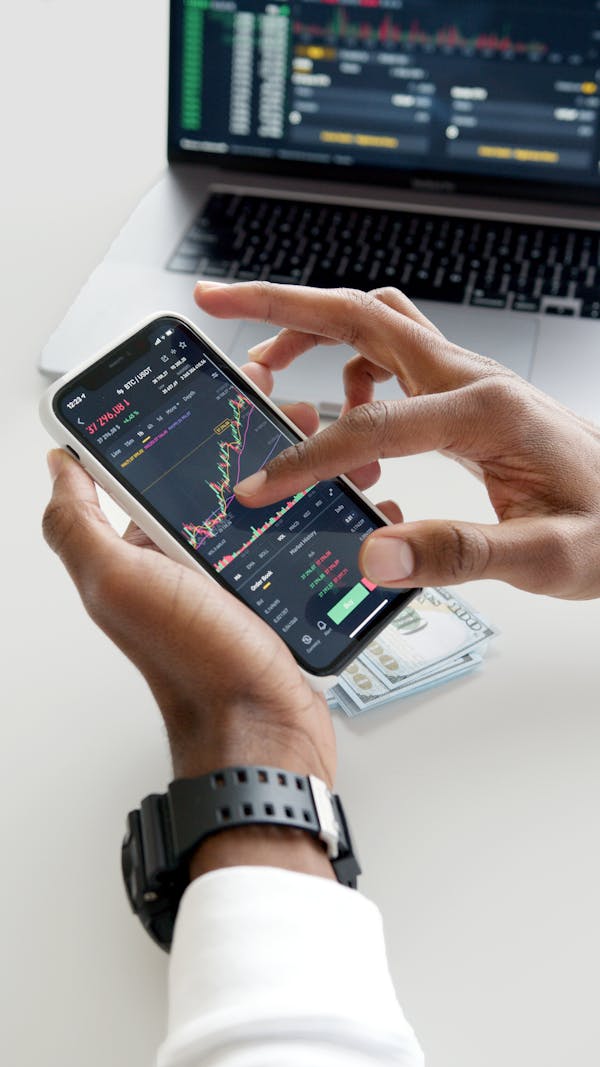 17
17Stop-Loss & Take-Profit
Pre-set exit orders that define exactly where you'll close a trade — removing emotion from the decision entirely.
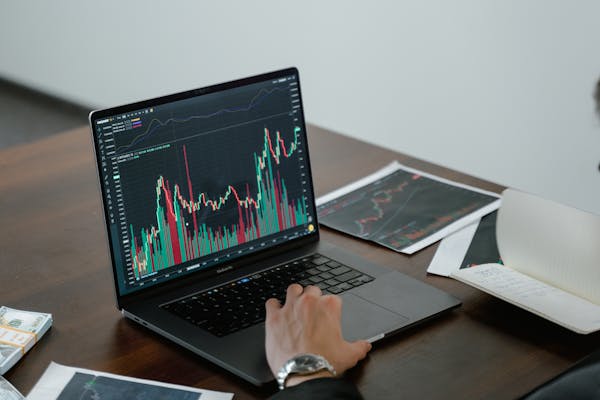 18
18Spot vs Futures Trading
Two fundamentally different approaches to crypto markets. Understand the distinction before deciding which path to pursue.
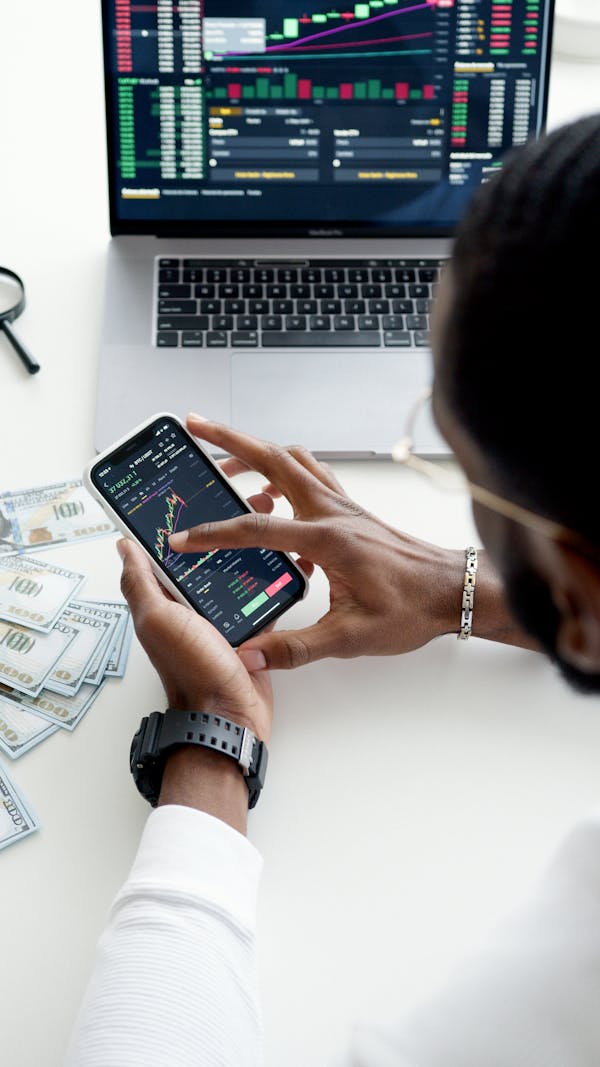 19
19Common Beginner Mistakes
Every successful trader has a graveyard of early mistakes. Learning from others' errors accelerates your growth immensely.
 20
20Building Your First Trading Plan
A written document defining every aspect of your trading approach. No professional trader operates without one. Start yours today.
What is Leverage?
$100 × 10x = $1,000 Position
Leverage amplifies gains AND losses equally
Leverage allows you to control a larger position than your actual capital. If you have $100 and use 10x leverage, you control a $1,000 position. This means a 1% price move generates a 10% gain (or loss) on your capital. Leverage amplifies both profits and losses equally.
Crypto exchanges like Binance offer up to 125x leverage on futures contracts. At 125x, a mere 0.8% move against you wipes out your entire position — this is called liquidation. Your position is automatically closed, and your margin is lost completely.
Professional traders rarely use leverage above 5x–10x. They understand that leverage doesn't change probability — a trade isn't more likely to win because you used higher leverage. What changes is the consequence: leverage turns small losses into account-destroying events.
If you're a beginner, start with spot trading (no leverage). When you explore leverage, begin with 2x–3x and always use strict stop-losses. Calculate your position size so a losing trade only risks 1-2% of total capital. Leverage is a precision tool — in expert hands it builds wealth; in untrained hands it guarantees ruin.
Leverage Multiplier Effect
Order Types: Market, Limit, Stop
Market · Limit · Stop
Three order types every trader must master
Understanding order types is fundamental to executing trades effectively. Every exchange offers three primary order types, each serving a different purpose in your trading strategy.
A Market Order executes immediately at the current best available price. It guarantees execution but not price — in volatile markets, the fill price may differ (slippage). Use market orders when speed matters more than price, such as closing a losing position quickly.
A Limit Order lets you set a specific price. A buy limit executes only at your price or lower; a sell limit at your price or higher. Limit orders give price control but don't guarantee execution — if the market never reaches your price, the order stays unfilled.
A Stop Order triggers a market order when price reaches a specified level. Stop-losses protect you from excessive losses by automatically closing your position. Professional traders use all three in combination: limit orders for entries, stop-losses for protection, and market orders for emergencies.
Trading Fees & How to Minimize
Maker 0.1% + Taker 0.1% = Cost
Small fees compound into massive costs over time
Every trade you make incurs fees — and over time, these fees can significantly eat into your profits. Most exchanges charge maker fees (adding liquidity via limit orders) and taker fees (removing liquidity via market orders).
On Binance, the default is 0.1% for both. A $10,000 trade costs $10 in fees each way, totaling $20 per round trip. This compounds dramatically over hundreds of trades.
Strategies to minimize fees: use limit orders instead of market orders for lower maker fees. Hold the exchange's native token (BNB on Binance) for a 25% discount. Increase trading volume to unlock VIP tiers with reduced rates.
Beyond trading fees, watch for withdrawal fees, funding rates on leveraged positions, and conversion fees. High-frequency traders should especially focus on fee optimization — a 0.05% difference compounds dramatically. Always factor fees into your profit calculations.
Risk Management 101
Never Risk More Than 1-2% Per Trade
The golden rule of professional risk management
Risk management is the single most important skill in trading — more important than any indicator, pattern, or strategy. Professional traders survive not because they never lose, but because they control how much they lose.
The golden rule: never risk more than 1-2% of your total trading capital on a single trade. If your account is $10,000, maximum loss per trade should be $100-$200. Even 10 consecutive losses only draws down 10-20% — recoverable.
Position sizing implements this rule. Formula: Position Size = (Account × Risk %) / (Entry Price − Stop-Loss Price). This ensures every trade risks the same percentage regardless of leverage, asset, or setup.
Additional principles: never move your stop-loss further from entry, diversify across multiple assets, avoid trading with money you can't afford to lose, and take regular breaks. The market will always be there tomorrow — your job is to make sure your capital is too.
What is RSI?
RSI: 0 — 30 — 70 — 100
Oversold → Neutral → Overbought — momentum at a glance
The Relative Strength Index (RSI) is one of the most popular momentum indicators. Developed by J. Welles Wilder in 1978, RSI measures the speed and magnitude of recent price changes. It oscillates between 0 and 100.
RSI above 70 suggests overbought — the asset may be due for a pullback. RSI below 30 suggests oversold — it may be due for a bounce. The default uses a 14-period lookback, though many crypto traders use 7 or 21 periods.
However, RSI is more nuanced than simply buying at 30 and selling at 70. In strong uptrends, RSI can remain above 70 for extended periods. Divergence — when price makes a new high but RSI makes a lower high — is a powerful reversal signal.
Use RSI as a confirmation tool alongside support/resistance and candlestick patterns, not as a standalone signal. Combine with volume analysis for greater accuracy. No single indicator is perfect — RSI works best as one component of a comprehensive system.
RSI Indicator (Relative Strength Index)
Moving Averages: SMA vs EMA
SMAslower, stableEMAfaster, responsive
Golden Cross (50 > 200) = Bullish · Death Cross (50 < 200) = Bearish
Moving averages are trend-following indicators that smooth out price data to reveal the underlying direction. They're among the most widely used tools in technical analysis.
The Simple Moving Average (SMA) calculates the arithmetic mean over a specified period. A 50-day SMA adds the last 50 closing prices and divides by 50. It gives equal weight to all data points, making it slower but more stable.
The Exponential Moving Average (EMA) gives more weight to recent prices, making it faster and more responsive. Better for short-term trading but generates more false signals during sideways markets.
Common strategies: the "Golden Cross" (50-day MA crosses above 200-day — bullish) and "Death Cross" (opposite — bearish). Many crypto traders use the 9 EMA and 21 EMA for short-term, and 50 SMA and 200 SMA for the major trend. Price above the 200-day moving average is generally bullish.
SMA vs EMA Comparison
Stop-Loss & Take-Profit
Take Profit ↑Entry ●Stop Loss ↓
Minimum 2:1 risk-reward ratio for consistent profitability
A stop-loss (SL) and take-profit (TP) are pre-set exit orders that define exactly where you'll close a trade — removing emotion from the decision. Every professional trader uses both on every single trade.
Your stop-loss should be placed where your trade thesis is invalidated — below support for longs, above resistance for shorts. Never place stops at round numbers or obvious levels where market makers hunt liquidity.
Your take-profit should target the next significant resistance (for longs) or support (for shorts). The key metric is risk-to-reward ratio (R:R). Risking $100 should aim for at least $200 profit (2:1 R:R). With 2:1, you can be wrong 60% of the time and still profit.
Advanced approaches include trailing stop-losses (which follow price, locking in profits) and partial take-profits (closing half at first target, letting the rest run). Plan SL and TP before entering any trade — not after.
Stop-Loss & Take-Profit Zones
Spot vs Futures Trading
SPOTvsFUTURES
Own the asset vs trade the contract — fundamentally different approaches
Spot trading and futures trading are fundamentally different approaches. In spot trading, you buy and own the actual cryptocurrency. There's no leverage, no liquidation risk, and no expiration date. Ideal for beginners.
Futures trading involves contracts that speculate on future price movement without owning the asset. You can go "long" (profit from increases) or "short" (profit from decreases), and use leverage. However, futures carry liquidation risk.
Key differences: spot has no funding fees; futures incur periodic funding charges. Spot profits are limited to upside; futures allow profiting in both directions. Spot has no liquidation risk; futures can liquidate your entire margin.
Start with spot trading to build experience. Only transition to futures after you're consistently profitable on spot, understand risk management deeply, and can handle the psychological pressure of leveraged positions.
Spot vs Futures Comparison
Common Beginner Mistakes
⚠ Top Beginner Mistakes
FOMO · Overleveraging · No Stop-Loss · Revenge Trading · Ignoring Fees
Every successful trader has a graveyard of early mistakes. Trading without a plan is the number one killer. Entering trades based on gut feelings, social media hype, or FOMO is gambling, not trading. Every trade needs a defined entry, stop-loss, take-profit, and position size.
Overleveraging is the fastest way to zero. Beginners often use 20x–50x leverage chasing quick profits, only to get liquidated on normal market fluctuations. Start with 1x (spot) or 2x–3x at most.
Revenge trading — immediately entering another trade after a loss to "make it back" — leads to emotional spiral and compounded losses. After a losing trade, step away and analyze what went wrong.
Other critical mistakes: not using stop-losses, investing money you can't afford to lose, ignoring fees, holding losers hoping they'll recover, chasing pumps, following anonymous influencers blindly, and neglecting continuous learning. Trading is a skill — treat it like a profession, not a lottery ticket.
Building Your First Trading Plan
Your Trading Plan = Your Edge
Entry Rules · Exit Rules · Risk Rules · Journal · Review Weekly
A trading plan is a written document that defines every aspect of your trading approach — from strategy rules to risk management to emotional guidelines. It's your personal playbook that removes guesswork and emotion.
Your plan should include: trading style (day/swing/position), markets and timeframes, specific entry criteria, exit criteria, risk rules (max risk per trade, max daily loss, max drawdown), and trading schedule.
Example entry criteria: "Enter long when price bounces off major support with a bullish engulfing candle, RSI below 40 turning up, and volume increasing — with stop-loss below support and take-profit at next resistance with minimum 2:1 risk-reward."
Include a journaling requirement: record every trade with reason, outcome, and lessons learned. Review weekly to identify patterns. The plan is a living document — refine it as you gain experience, but never abandon it mid-trade. Discipline is the bridge between a good plan and consistent profits.
← Previous PagePage 2 of 2