
- What intraday trading means in a 24/7 crypto market
- Trading sessions, volatility windows, and when to actually trade
- VWAP — the single most important intraday tool
- Three high-probability intraday setups
- The opening range breakout, demystified
- Risk management for intraday traders
- A complete intraday trade — entry to journal
- Automating the tedious parts with signal engines
- Frequently asked questions
What intraday trading means in a 24/7 crypto market
Intraday trading — often called day trading — is the practice of opening and closing all positions within a single trading day. You never hold overnight. In traditional markets, "the day" is a fixed 6-7 hour window (NSE is 09:15 to 15:30 IST). In crypto, the market never closes — so intraday in crypto means something slightly different: positions opened and closed within a single self-defined trading session, usually 4-8 hours.
Intraday traders target price moves of 1-3%, hold trades for 30 minutes to 4 hours, and typically place 3-8 trades per day. It sits between scalping (seconds to minutes) and swing trading (days to weeks) — offering more action than swing but less neurological punishment than scalping.
The crypto-specific twist matters. Because the market doesn't close, there's no natural session boundary telling you when to stop. You have to build your own. The most common approach is to pick one of the three global sessions — Asian (6 AM-2 PM IST), European (1 PM-9 PM IST), or US (6:30 PM-2:30 AM IST) — and trade only within that window. Attempting to day-trade 24 hours a day is physically impossible and mentally destructive. Pick your session.
For most Indian retail traders, the best option is the US session in the evening (6:30 PM onwards) because it overlaps with post-work hours and contains the highest-volatility windows of the day. The morning Asian session is second-best for those who work night shifts or start late.
Trading sessions, volatility windows, and when to actually trade
Not all hours are equal. Crypto volatility clusters around specific times of day, and trading outside those windows is a slow bleed — low-quality setups, wide spreads relative to movement, and worse fills.
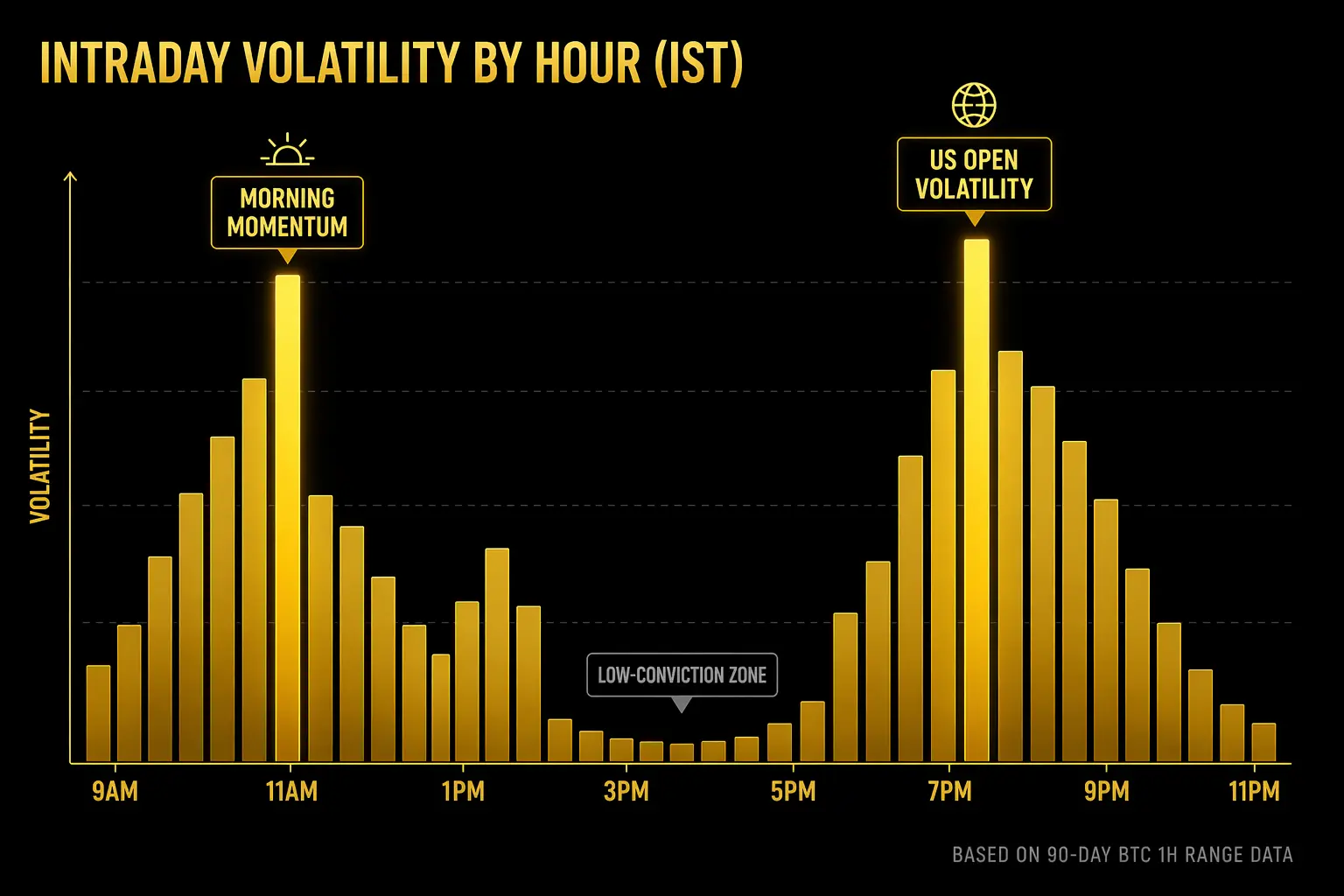
Crypto volatility is concentrated in specific hours — trade those, avoid the dead zones.
Peak volatility windows (IST):
- 9:00 AM - 11:00 AM — Asian session peak, overlaps with Indian equity market open, major Asian macro news releases. Good for BTC/ETH.
- 1:00 PM - 3:00 PM — London open transfer, European macro releases.
- 6:30 PM - 9:30 PM — US equity market open, overlaps with European close. The most volatile window in all of crypto. This is where 60% of intraday opportunities live for Indian traders.
- 11:30 PM - 1:30 AM — US late session, often contains the day's liquidity sweeps.
Avoid these hours:
- 3:00 PM - 5:30 PM IST — Low-volume gap between European morning and US open. Setups fail often.
- 3:00 AM - 6:00 AM IST — Thinnest liquidity of the day. Spreads widen, stops get hunted.
- Sunday evenings — Weekend dead zone before the Monday Asian session rebuilds volume.
The single most valuable rule in intraday trading: match your sessions to high-volume windows. The evening US session (6:30 PM - 10:30 PM IST) is perfect for most Indian working professionals — it starts right after office hours, covers the most volatile period, and ends before you lose sleep. If you can only trade one session, trade this one.
VWAP — the single most important intraday tool
The Volume-Weighted Average Price is the intraday trader's spine. It is the average price at which the asset has traded throughout the day, weighted by volume. Every algorithmic trading desk watches it. Every institutional execution algorithm benchmarks to it. If you ignore VWAP while day-trading crypto, you are trading blind against people who aren't.
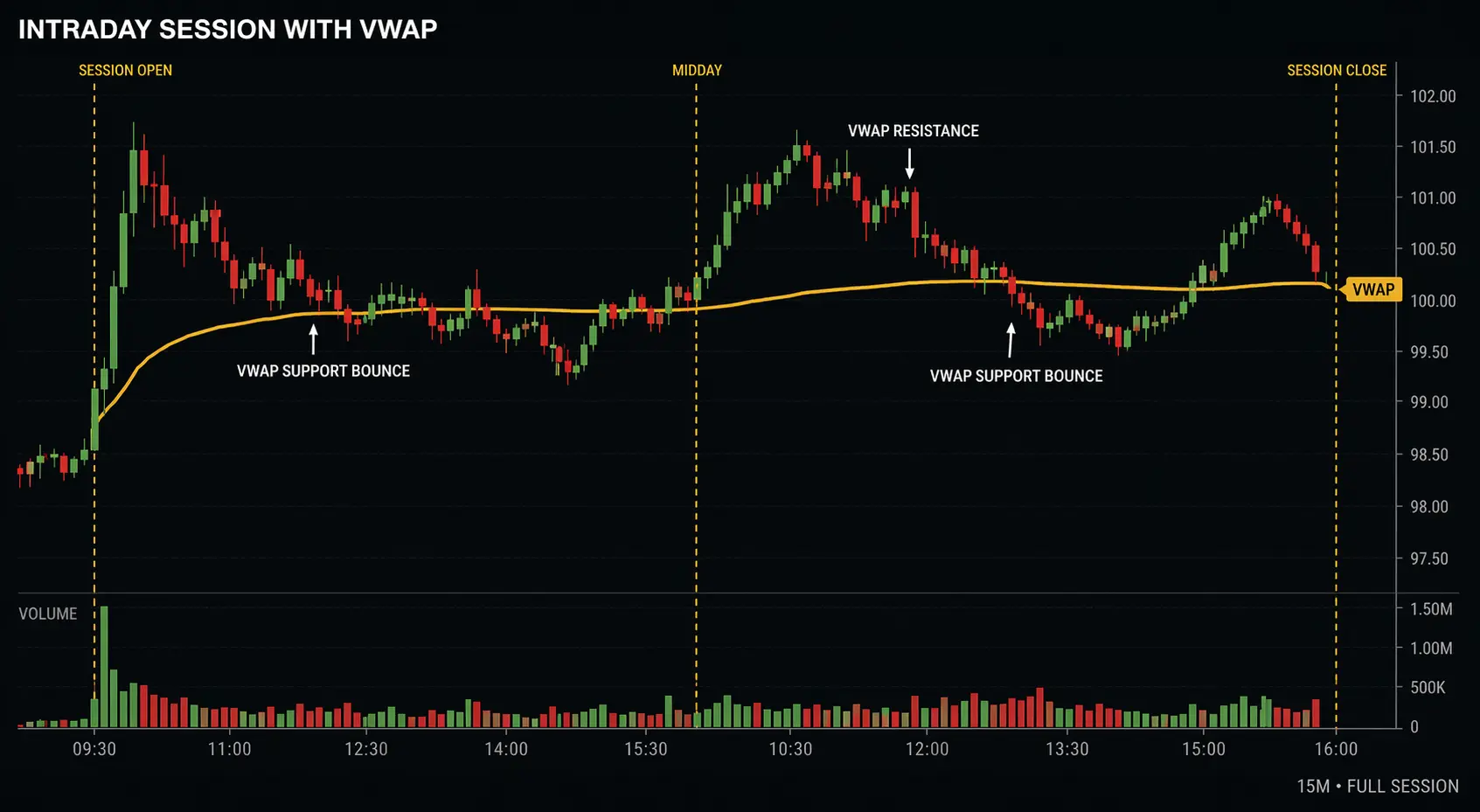
VWAP running through the middle of the session — acting as support on pullbacks, resistance on rallies.
Three things VWAP tells you at a glance. Market bias: if price is consistently above VWAP, buyers are in control of the session. Consistently below means sellers own it. Dynamic support/resistance: price pulling back to VWAP often bounces from it, making VWAP a high-quality entry zone. Mean-reversion signal: when price extends 1-2% away from VWAP, the probability of a pullback to VWAP rises sharply.
The most profitable VWAP setup for Indian intraday traders is the VWAP reclaim. Price is below VWAP most of the morning, then breaks above it decisively on rising volume. You enter on the break, stop below the last swing low, target either the day's high or the prior day's VWAP. This setup has worked across multiple market regimes for years. It works because it's what algorithms are also looking for.
One caveat: VWAP resets daily. The VWAP from yesterday is irrelevant — what matters is today's running VWAP. Set your charting software to show the current session's VWAP only.
Three high-probability intraday setups
Hundreds of intraday setups exist online. Most have marginal or no edge after fees. These three are the ones I've personally journaled over five years and have positive expected value across bull, bear, and ranging regimes.
Setup 1 — VWAP Pullback. On a trending day (price clearly above VWAP, making higher highs), wait for a pullback to VWAP. Enter long on the first bullish candle closing back above VWAP. Stop below the pullback low. Target the day's high or 1:2 R:R, whichever is closer. Works best between 7 PM and 10 PM IST.
Setup 2 — Opening Range Breakout (ORB). Detailed in its own section below. This is the cleanest intraday setup in crypto because it has a precise entry, a precise stop, and a precise target — the three ingredients of any systematic strategy.
Setup 3 — Failed Breakout Reversal. Price breaks a clear horizontal level (either direction) but fails to hold — closes back inside the range within 2 candles. Enter in the opposite direction of the failed break. Stop just beyond the breakout extreme. Target the opposite side of the range. This setup exploits trapped traders and often produces the biggest 1:3+ moves.
Notice what's missing from this list: RSI overbought/oversold scalps on the 5-minute, MACD crossover signals on 15-minute, MA crossovers on 1-hour. These patterns generate enough signal on their own for swing traders, but on intraday timeframes they produce far too many false signals to be the basis of a profitable system. They're useful as confluence filters — for the RSI filter logic in particular, our RSI trading guide covers how to use RSI as confirmation.
The opening range breakout, demystified
The opening range breakout is the oldest intraday strategy in the world, adapted from equity markets where it has worked for nearly 100 years. In crypto, it works best when applied to a self-defined session, most commonly the US session open at 6:30 PM IST.
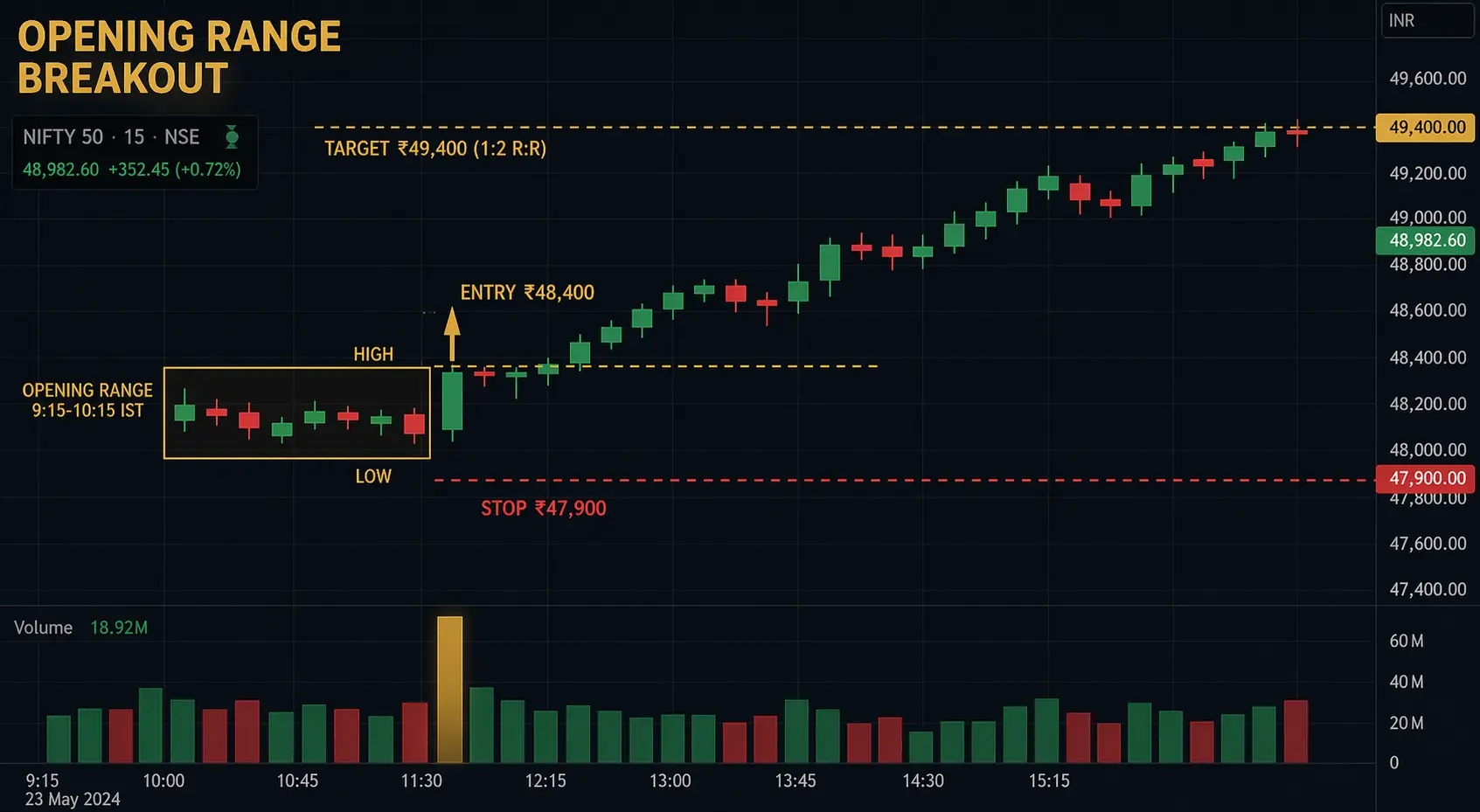
First-hour range boxed, breakout candle marked, stop inside the range, target at 1:2 R:R — a clean ORB.
The rules:
- Define your session open (e.g., 6:30 PM IST for the US session).
- Let the first 60 minutes form a range. Mark the high and low of that first hour as the opening range.
- Wait for price to break the range decisively — a full candle close outside, with volume above the session average.
- Enter on the close of the breakout candle. Stop on the opposite side of the opening range. Target at least 1:2 R:R, often 1:3 for strong breaks.
Why it works. The opening range represents the market's initial price discovery after a major session handover. A break of that range with volume indicates fresh directional conviction. Traders who positioned inside the range on the wrong side become liquidity as price runs.
Realistic expectations. ORB produces roughly 1-2 qualified setups per week on BTC. It does not fire every day. Beginners often try to "force" an ORB by lowering their range definition to 15 minutes — this destroys the edge. Patience with the 60-minute definition is what makes ORB profitable over 100+ trades.
For macro structure context that dramatically improves ORB win rate, read our guide on crypto market cycles — ORB longs in bear regimes have much lower edge than ORB longs in bull regimes. Trade the macro regime, not just the intraday chart.
Risk management for intraday traders
Intraday traders lose money for two reasons: bad setups, and good setups sized badly. The second reason accounts for more blow-ups than the first. Here are the non-negotiable risk rules.
Risk per trade: 1% maximum. On a ₹2,00,000 account, that's ₹2,000 at risk per trade. Even a 40% win rate at 1:2 R:R is profitable with disciplined sizing. At 2% risk per trade, one bad session (3-4 losing trades) wipes out 6-8% of the account — a drawdown that's psychologically very hard to recover from.
Daily loss limit: 3%. After three losing trades or a 3% account drawdown, stop trading for the day, no exceptions. Revenge trading after three losses has destroyed more accounts than any specific strategy failure. Close the laptop. Walk. Come back tomorrow.
Weekly review gate. If you finish the week down more than 6%, reduce your risk per trade to 0.5% the following week and trade smaller until you recover two consecutive green weeks. This dynamic sizing protects you from the death spiral where a bad week leads to oversized revenge trades.
No trading on macro news days. CPI releases, FOMC meetings, major geopolitical events — avoid intraday setups in the 2 hours before and 1 hour after these releases. Crypto spikes unpredictably on macro news, and most intraday setups fail through the whipsaw.
Leverage: 2-3x maximum. Intraday traders rarely need more than 3x leverage to reach meaningful position sizes. Going higher doesn't increase edge — it just increases the chance of liquidation on a normal intraday wick. For the brutal math on why higher leverage fails, read our leverage trading guide.
A complete intraday trade — entry to journal
Let's walk through one full intraday trade using the VWAP pullback setup. Account: ₹3,00,000. Risk per trade: 1% (₹3,000). Pair: ETH/USDT. Session: US open, 6:30 PM IST.
6:30 PM — Session opens. ETH trading at ₹2,65,000. Establish session VWAP reference.
7:15 PM — Trend establishes. ETH has rallied to ₹2,68,500, clearly above VWAP which sits at ₹2,66,200. Bullish bias confirmed.
7:45 PM — Pullback begins. ETH pulls back from ₹2,69,000 toward VWAP. Volume declines during pullback — healthy, not panic selling.
8:05 PM — Setup triggers. ETH touches VWAP at ₹2,66,300, forms a bullish engulfing candle on rising volume, closes at ₹2,66,800. Enter long.
Sizing calculation. Stop at ₹2,65,800 (just below VWAP and pullback low). Risk per ETH = ₹1,000. With ₹3,000 total risk, buy 3 ETH = ₹8,00,400 position. Using 3x leverage on a ₹3,00,000 margin, this works.
8:45 PM — Trade develops. ETH grinds back toward the session high. Target 1 at the prior high (₹2,69,000) fills on the first touch.
9:20 PM — Extension target. ETH breaks through session high, extends to ₹2,71,500. Take final profit. Session ends.
Journal entry. Profit breakdown: 1.5 ETH exited at ₹2,69,000 (+₹3,300). 1.5 ETH exited at ₹2,71,500 (+₹7,050). Gross profit: ₹10,350. Fees (~0.1% round trip on ₹8,00,400): ₹800. Net profit: ₹9,550. That's ~3.2% return on the ₹3,00,000 account in a 3-hour session. Not every day works this cleanly — you'll have losing sessions — but this is what a textbook intraday trade produces when the setup aligns.
Automating the tedious parts with signal engines
Intraday trading rewards two skills: pattern recognition and execution discipline. Neither scales without tooling. Flipping through 15 coins every 15 minutes looking for VWAP pullbacks is unsustainable past month two.
DRISHTIKON — Intraday signals engineered for focus
DRISHTIKON, the signal engine inside CHAKRAVYUH, continuously monitors VWAP alignment, opening range conditions, volume surges, and momentum shifts across BTC, ETH, SOL, BNB, XRP and other majors on 15-minute and 1-hour timeframes. When a setup meets all criteria, you get an alert with proposed entry, stop, and target levels already calculated.
You still decide whether to take the trade. DRISHTIKON just handles the watchlist scanning so you can focus on execution.
Explore Chakravyuh →Manual or automated, the core principles don't change. Trade in the right session. Respect VWAP. Size with 1% risk. Stop trading after three losses. Journal every trade. Review weekly.
If intraday feels like too much active engagement, swing trading may fit your life better. If you want the structured learning path, our trading courses include a full intraday module with live session recordings. The Telegram community runs daily setup threads during the evening US session.
Frequently asked questions
What is the best time to intraday trade crypto from India?
The US session from 6:30 PM to 10:30 PM IST is the single best window for most Indian working professionals. It overlaps with the highest-volatility period in crypto, it happens after office hours, and it ends early enough to maintain sleep. The morning Asian session (9 AM - 11 AM IST) is a secondary option for those with flexible mornings.
How much capital is needed to intraday trade crypto?
Realistic minimum is ₹1,00,000-₹2,00,000. Below ₹1,00,000, fees and lot-size minimums make the math unfavourable. With ₹2,00,000 and 1% risk per trade (₹2,000), you can take meaningful positions in majors like ETH and SOL while maintaining proper risk management. Scaling up, most consistent intraday traders operate accounts between ₹3 and ₹10 lakh.
Is intraday trading profitable for beginners?
Most beginners lose money in their first 6-12 months of intraday trading. The learning curve is steep — reading VWAP, sizing correctly, managing emotions, and surviving drawdowns all take time. Realistic expectation: breakeven by month 9-12 if disciplined, consistently profitable from year 2 onwards. Beginners should paper-trade for 1-2 months before risking real capital.
What's the difference between intraday trading and scalping?
Time horizon and trade frequency. Scalpers hold positions for seconds to minutes and place 20-40 trades per day; intraday traders hold for 30 minutes to 4 hours and place 3-8 trades per day. Intraday is structurally friendlier to retail traders because fees and slippage are a smaller percentage of each trade's P&L. Most beginners who try scalping should be intraday trading instead.
Do I need leverage to intraday trade crypto?
No. Spot intraday trading is perfectly viable and far less risky than leveraged intraday. If you do use leverage, keep it to 2-3x. Higher leverage dramatically increases liquidation risk without meaningfully improving edge. The most disciplined intraday traders I know use 2x maximum, and many trade spot only.
cRyPtO sMaRt is not registered with SEBI and does not provide investment advice. Crypto trading carries significant risk of capital loss. The strategies, examples, and opinions shared in this article are for educational purposes only. Always do your own research and consult a SEBI-registered financial advisor before investing real capital. Past performance does not guarantee future results.