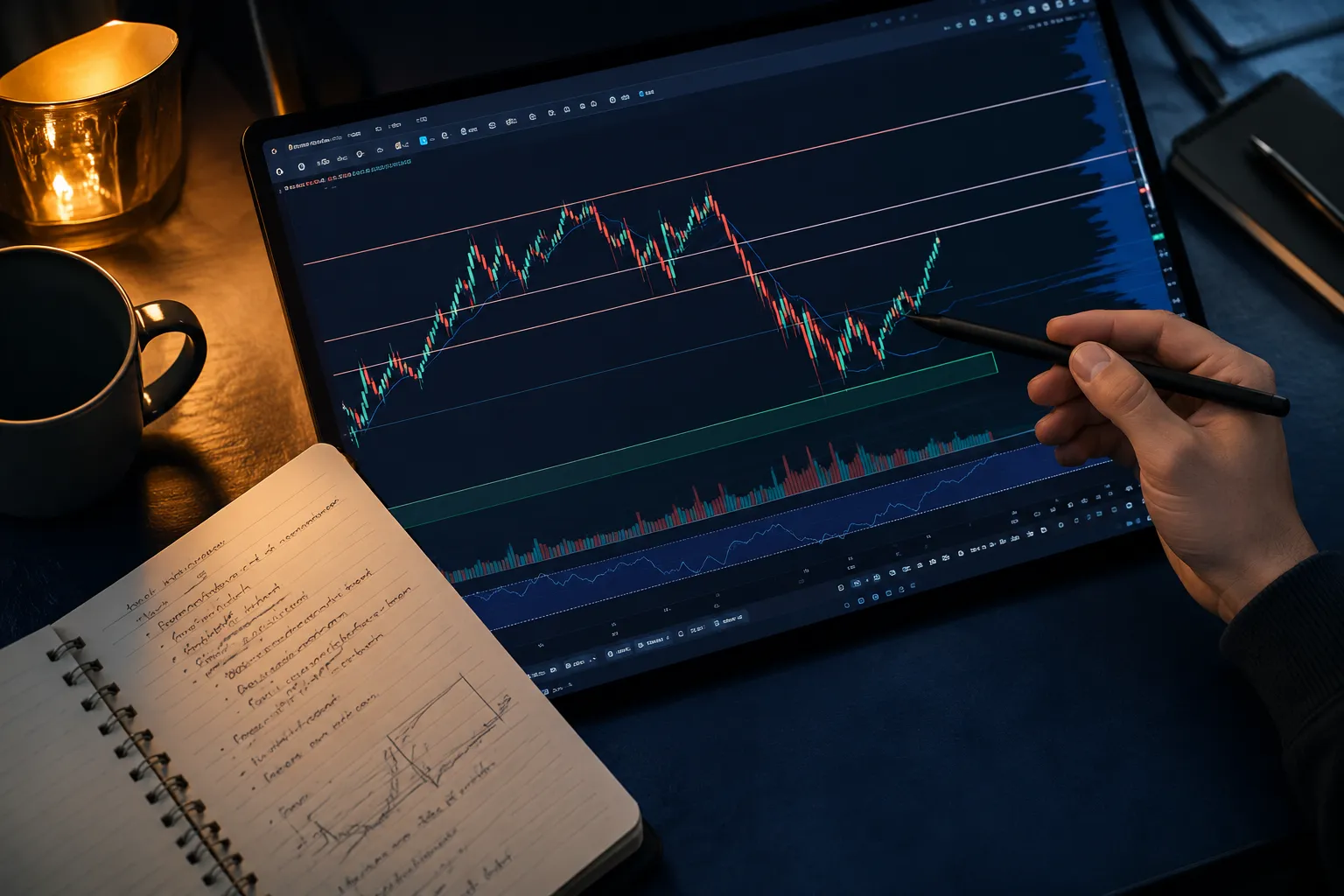
The style that lives between intraday and HODL — fewer trades, calmer days, often better after-tax results. Here's how it actually works.
By Avik Kanrar11 min readUpdated May 2026
Where swing trading sits
Swing trading is the middle path. Slower than intraday, busier than HODL — and structurally lighter on India's 30% crypto tax than active day-trading.
I trade intraday for a living — and I respect swing traders deeply. For most people, swing is the smarter starting place. Fewer decisions, calmer days, fewer taxable events, and a learning curve that doesn't punish you on day one. Here's the honest explanation of what swing trading actually is, why it works, and how to think about it as an Indian beginner.
What "swing trading" really means
A swing trader holds a position for several days to a few weeks — long enough to ride a meaningful price swing, short enough to avoid sitting through full market cycles. The idea is simple: identify a setup, enter near support, exit near resistance, and let the trade work over days rather than minutes.
Fewer trades = fewer taxable events under India's 30% rule.
Requires reading higher timeframes, not 1-minute charts.
Suits people with day jobs, families, or limited screen time.
Anatomy of a swing trade
Entry at support · exit at resistance · held over 12 sessions
That is the textbook anatomy: buy near support, exit near resistance, hold through the noise in between. The skill isn't predicting the future — it's identifying clean zones, sizing the trade properly, and not flinching during the holding period. A swing trader's edge is patience plus structure, not speed.
Why this style suits most Indian beginners
There are three honest reasons swing trading is often the wiser starting point in India:
1. The tax math is gentler. Every booked gain in India is taxed at a flat 30% plus 4% cess, with a 1% TDS on transfers and no loss set-off. The fewer trades you take, the fewer taxable events you create. A patient swing trader who closes 30 trades a year faces a fraction of the tax friction an active intraday trader faces with 30 trades a month.
Trade frequency per year — roughly
More events = more 30% tax + 1% TDS friction. Fewer trades = lighter load.
2. You don't need to be at the screen all day. Swing setups develop on the 4-hour and daily charts, not the 1-minute. You can check the market once or twice a day, set your stop-loss and take-profit, and live your life. For anyone with a day job or family, this isn't a limitation — it's the whole appeal.
3. The learning curve is forgiving. Intraday punishes mistakes within minutes; swing gives you hours or days to recognise a bad trade and exit gracefully. Beginners learn far more from a single losing swing trade reviewed at leisure than from ten panicked intraday exits.
The honest tradeoffs
It isn't all gentler — there are real costs to swing that intraday traders don't face. Overnight risk is the big one: crypto trades 24/7, and a position held for a week is exposed to weekend news, global moves, and overnight liquidations. Lower win frequency is another: you take fewer trades, so good and bad results are less smoothed by volume. And capital is locked longer per trade, which can frustrate beginners who want the dopamine of constant action.
Swing trading rewards reading the bigger picture. The 1-minute chart is noise; the daily tells a story.
A simple framework for your first swing trades
This isn't a "guaranteed setup" — there are none — but a clean starting framework. One: identify the trend on the daily chart. Up-trends are gentler to swing-trade than down-trends. Two: mark clear support and resistance zones on the daily and 4-hour charts. Three: wait for price to test support with a confirming signal — a bullish candle, a RSI turn back up from oversold. Four: enter with a pre-defined stop-loss and take-profit, sized so the worst case loss is 1–2% of your capital. Five: walk away. Let the trade work.
If the trade hits your stop, you lose the predefined small amount and learn from it. If it reaches your target, you book the gain (yes, taxed at 30%, the math you already accept) and move on. The whole game is doing this consistently, not finding the "best" indicator.
Managing the trade once you're in
The entry is only the first 20% of a swing trade. What you do over the holding days matters just as much. Three habits separate traders who keep their gains from traders who give them back.
Don't watch it. Once your stop-loss and take-profit are set, the trade is on autopilot. Checking the chart every hour is how you talk yourself into closing winners early or moving stops on losers. Set your two daily check-ins and trust them. The position will be there when you look — that's the whole point of swing.
Move stops up, never down. If a trade goes in your favour by 5%, consider trailing your stop to break-even or above. That converts a winning trade into a "free trade" — you can't lose, only earn more. But never move a stop further away to "give it room." That's just delaying a loss that the market has already told you about.
Take partial profits if the move runs. If your target is hit early and the trend is still strong, consider booking half the position at target and trailing the rest. You lock in the planned win and let the runner work. This isn't greedy — it's letting the math work in both directions.
None of this is revolutionary. It's the boring discipline that separates "I made money this year" from "I made money and kept it." Swing trading rewards the trader who applies these habits 30 times, not the trader who finds one perfect setup.
~30/yr
A patient swing trader's typical trade count — small enough that the 30% tax stays manageable, large enough that the year still adds up.
How to spot a clean swing setup
Setups aren't magic — they're checklists you apply consistently. A clean swing setup, the kind I'd respect as worth taking, usually has four things going for it before you click buy. Master these and you've cut out 80% of the noise that traps beginners.
A real level, not a guessed line. Support and resistance only matter when price has visited them multiple times. One touch is coincidence; three or more touches is a level the market remembers. Mark only the lines price has respected — ignore the rest.
A trend you're trading with, not against. Look at the daily chart first. If higher highs and higher lows are stacking, you're in an uptrend — bias your trades long. Counter-trend trades exist, but they're harder, faster, and not where beginners build confidence.
A confirming signal at your level. Price hitting support is necessary but not sufficient. Wait for a confirmation: a bullish engulfing candle, an RSI turn back up from below 30, a clear rejection wick. The signal isn't a guarantee — it's the difference between "buying a falling knife" and "buying a tested floor."
A reward-to-risk ratio worth taking. If your stop-loss is 3% below entry and your take-profit is 4% above, you're risking ₹3 to make ₹4 — a fragile edge that has to win 50%+ of the time just to break even after tax. Aim for setups where reward is at least 2x your risk. Fewer setups will qualify; the ones that do will pay for the ones that don't.
What a swing trader's week actually looks like
This is the part beginners imagine wrong. They picture swing trading as "lazy intraday" — same intensity, fewer trades. The reality is much calmer, and that calmness is the entire point of the style.
Most swing traders I know have a routine that looks like this: a 20-minute morning chart review to check positions, mark fresh levels, and scan for new setups. A second 10-minute evening check to confirm stops and targets are set. That's it — under 40 minutes a day. No staring at one-minute candles, no anxiety spikes on every wick, no missed dinners because a setup is forming. The market is doing the work; you've already made the decisions.
The flip side is that the discipline shifts from action to inaction. You'll have days, sometimes weeks, with no good setup. The temptation to "force a trade" because you're bored or impatient is the single biggest swing-trading killer. Patience isn't a virtue here — it's a skill, and like any skill it takes practice.
Common swing-trading mistakes
The traps that catch swing traders are different from intraday's. Cutting winners too early is the most common — you booked +3% in two days, felt great, and missed the +12% that came over the next week. A pre-set take-profit at your target solves this. Moving the stop-loss when price approaches it ("just give it more room") turns small losses into account-killers. And over-allocating to one trade because "this one's obvious" — the obvious ones aren't obvious until they're history. Most of our 7 mistakes draining beginner accounts show up in swing trading too, just at a slower pace.
This is education, not financial advice. Risk management, position sizing, and tax planning should be reviewed with your own circumstances in mind; for tax specifically, a CA familiar with Indian crypto rules is worth the conversation.
The honest part
I trade intraday because it suits my temperament, hours, and the work I've put in over years. Swing trading would suit many of the people I teach better than copying me would. That's not a marketing line — it's a fact. The right trading style isn't the one with the most followers; it's the one you can do well, repeatedly, while still living the rest of your life. For most beginners, swing is that style.
Frequently asked questions
What is swing trading in crypto?
Swing trading is a style where you hold positions for several days to a few weeks, aiming to catch larger price swings instead of small intraday moves. It sits between intraday trading and long-term holding, and typically requires far less screen time than intraday.
Is swing trading better than intraday in India?
Neither is universally better. Swing trading suits people who can't watch charts all day, prefer fewer decisions, and value lower tax friction from fewer trades. Intraday can earn more per unit of time but demands experience, discipline, and screen presence. The right choice depends on your time, temperament, and capital.
How much capital do I need to swing trade crypto?
Start with money you can lose entirely without changing your life. Position size matters more than capital size — risk per trade should usually stay around 1 to 2 percent of your account. Many swing traders begin with modest capital and let the account compound over time.
Want the foundation under swing trading?
Free 20-lesson course — candlesticks, support and resistance, risk management. Honest, beginner-first, Indian context.