
- What scalping is — and what the gurus don't tell you
- Why 90% of retail scalpers lose money
- The brutal fee math every scalper must understand
- The three scalping setups that actually work
- Reading the order book like a scalper
- A complete scalp trade walked through
- The discipline requirements nobody warns you about
- Tools and automation for scalp-scale edge
- Frequently asked questions
What scalping is — and what the gurus don't tell you
Scalping is the shortest-duration form of trading — positions held for seconds to minutes, targeting tiny price moves of 0.2% to 0.8%. A typical scalper enters and exits 20-40 times a day, sometimes more. Each individual trade captures very little. The goal is to stack hundreds of tiny wins over months.
On paper, it sounds like a math-rich, edge-based game played by elite traders. In reality, scalping is the style where retail traders lose money the fastest. The gap between scalping's theoretical appeal and its practical brutality is bigger than any other style.
Here is what the YouTube videos never show you: the average retail scalper blows their account within 3-6 months. Not because scalping cannot work — it demonstrably does for institutions and a small group of full-time professionals — but because the structural disadvantages stacked against retail scalpers are enormous. Fees, slippage, speed of execution, broker/exchange disadvantages, emotional exhaustion — each of these alone is enough to wreck a retail scalper. Combined, they are almost always fatal.
This guide is not going to teach you how to get rich scalping. It will teach you what scalping actually is, the real math of fees and slippage, and the honest question of whether scalping is a style you should attempt at all. If after reading you decide it's not for you, we've done our job. If you still want to pursue it, you'll do so with eyes open.
Why 90% of retail scalpers lose money
The failure rate is not due to lack of skill or discipline. It's structural. Here are the five forces that work against every retail scalper, all the time.
Force 1 — Fees. Indian exchanges charge 0.1% to 0.25% per trade. On a round-trip (buy + sell) that's 0.2% to 0.5%. If your average scalp targets 0.5%, you're giving up 40-100% of your profit to fees. On many trades, fees exceed the profit entirely.
Force 2 — Slippage. Market orders rarely execute at the exact price you want. In fast-moving crypto markets, slippage of 0.05-0.15% per side is common on mid-cap altcoins — adding another 0.1-0.3% cost on every round-trip.
Force 3 — 1% TDS. India's 1% TDS on every crypto sell applies to every scalp. A trader making 30 trades a day triggers 30 TDS events. While TDS is recoverable at year-end, the cash-flow drag is severe and the paperwork is punishing.
Force 4 — Latency. Institutional scalpers execute orders in microseconds with co-located servers. You are placing orders from your home wifi, potentially through a mobile app. By the time your order reaches the exchange, the price has moved. This is not paranoia — it's physics.
Force 5 — Emotional cost. Scalping demands 6-10 hours of unbroken focus. Human attention does not sustain that. Fatigue-driven decisions near hour 6 are responsible for most scalping blow-ups. The style is neurologically expensive in a way that swing trading simply isn't.
Add these up and you get a structural 1.5-2% cost drag per round-trip trade. You must have a genuine edge exceeding this just to break even. Most retail scalpers do not have that edge — they are essentially paying the exchange 2% per trade for the privilege of losing money faster.
The brutal fee math every scalper must understand
Let me make this concrete with ₹ numbers you can verify on your own exchange statement.
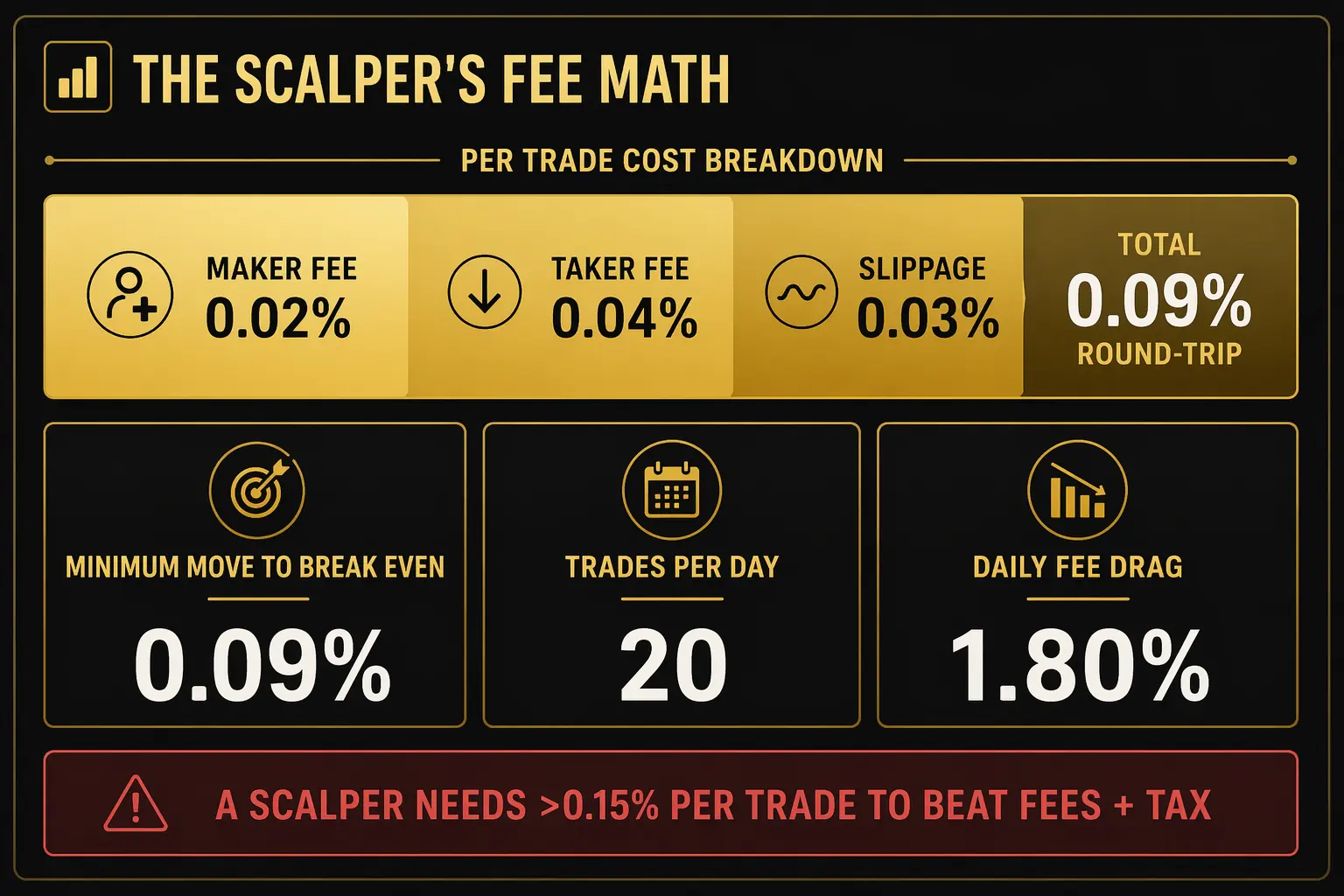
The scalper's math — round-trip costs add up to a minimum 0.09% move just to break even before profit.
Assume you trade on a mid-tier Indian exchange with 0.1% maker and 0.1% taker fees, and you use market orders (taker) for both entry and exit.
Round-trip cost: 0.1% entry + 0.1% exit = 0.2% fees alone. Add typical 0.05% slippage per side = 0.3% total friction.
Minimum move to break even: 0.3%. Every trade that doesn't move at least 0.3% in your favour is a losing trade — even if price went nowhere.
On 20 trades per day, with a 50% win rate: 10 winners at 0.5% (net 0.2% after costs) = +2.0%. 10 losers at -0.5% (net -0.8% after costs) = -8.0%. Daily result: -6% on trading capital. If you started with ₹1,00,000, you'd be at ₹94,000 after one day and below ₹50,000 within two weeks.
To merely break even scalping at 20 trades/day, you need a win rate of roughly 62-65% at 1:1 R:R. To be profitable in any meaningful sense, you need 70%+. Institutional scalpers with low fees and microsecond execution target 55-60% and it works for them because their structural costs are near zero. Your costs are not near zero.
This is why we tell every beginner asking about scalping to first build a month of positive results on swing trading or intraday. If you cannot profit at those styles where the fee drag is 10-20x lower, scalping is mathematically hopeless.
The three scalping setups that actually work
If you've read the math above and still want to try scalping, these are the only three setups I would touch with real capital. All three are designed for high-liquidity pairs (BTC, ETH) on the 1-minute timeframe, during high-volatility sessions.
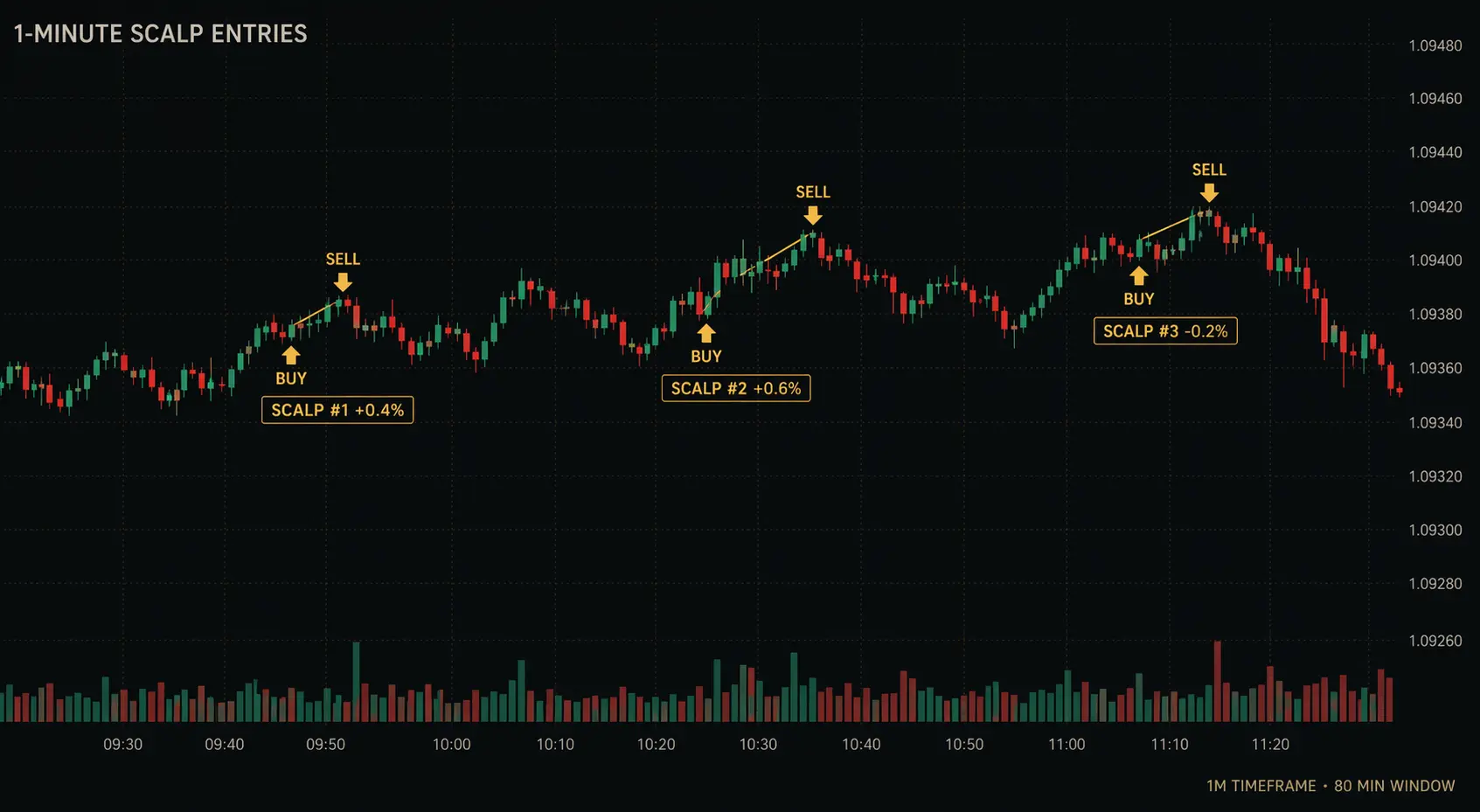
Three scalp trades on a 1-minute chart — entry, 3-5 candle hold, exit. Quick but relentless.
Setup 1 — VWAP Bounce. On a strongly trending day, price pulls back to the Volume-Weighted Average Price (VWAP) on the 1-minute chart. When a bullish candle closes above VWAP, enter long. Stop 0.3% below the pullback low. Target 0.5-0.8%. This works because VWAP is watched by algorithmic traders and tends to act as dynamic support.
Setup 2 — Range Break. On a ranging 1-minute chart with a clear horizontal ceiling/floor, wait for a candle to close decisively outside the range with above-average volume. Enter in the direction of the break. Stop back inside the range. Target 1-1.5x the range height. This works because tight ranges build energy that releases in sharp directional moves.
Setup 3 — News Catalyst Scalp. Major news (CPI, Fed announcement, major exchange listing) triggers 1-2% moves in seconds. If you have pre-positioned orders above the range in the direction of the expected move, you catch the release leg. This is the highest-return scalp setup but also the highest-risk due to slippage on the news spike.
Every other scalping setup you'll find on YouTube — RSI oversold scalp, MA crossover scalp, random breakout scalp — has an edge close to zero after fees. Don't waste your time. Stick to these three, or find a different trading style.
Reading the order book like a scalper
The order book is the scalper's single most important tool. It shows you all the buy and sell orders waiting at each price level — the raw supply and demand of the market in real time. Chart patterns lag; the order book is live.
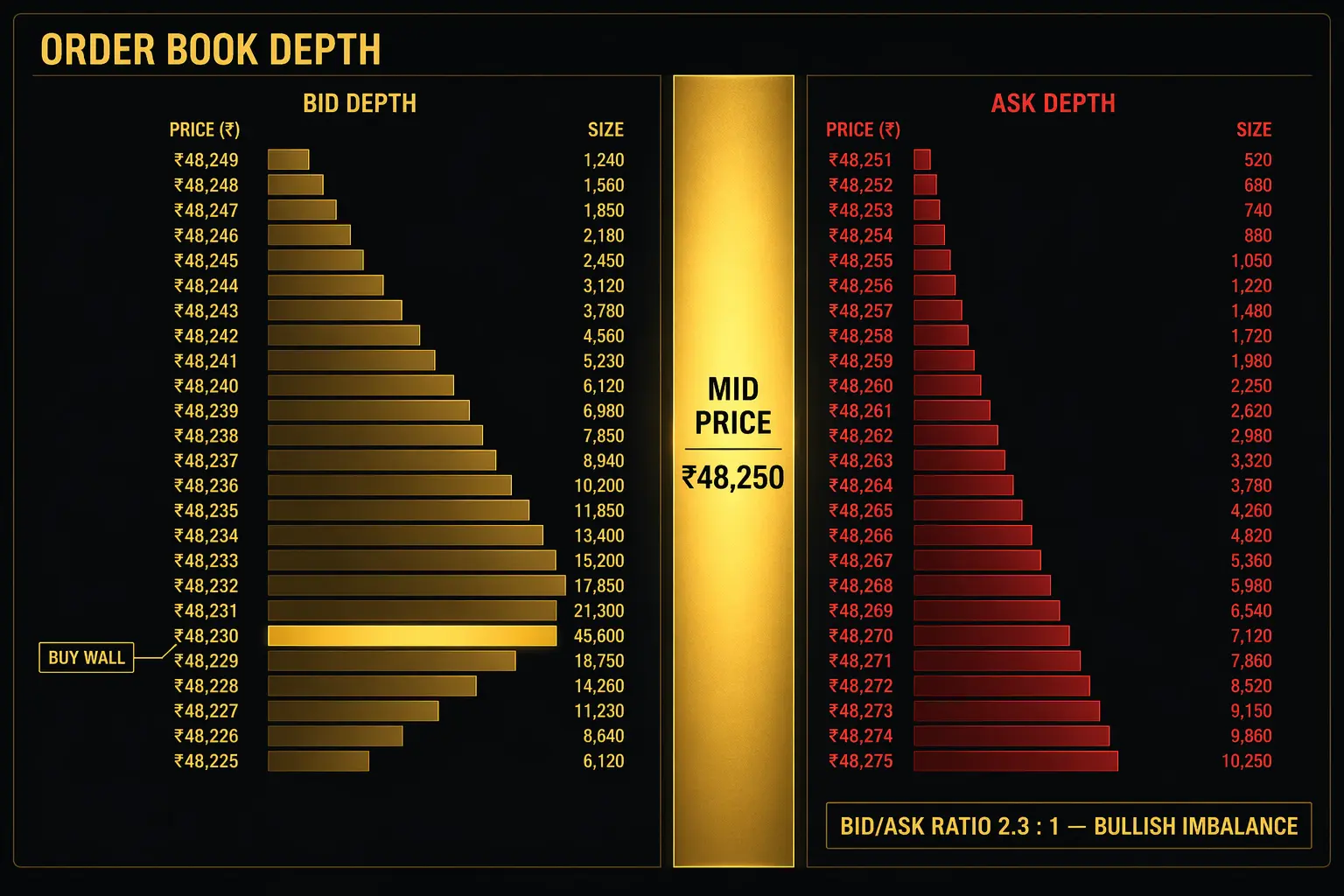
An order book with a strong bid wall — a bullish imbalance visible to anyone who looks beyond the chart.
Three order book signals are actionable for scalpers. Bid/ask imbalance: if total bid size is 2x or more the total ask size within a few price levels, short-term pressure is bullish. The reverse is bearish. Walls: a single large order at one price level acts as psychological support or resistance — price often tests and respects walls unless they are absorbed. Spoofing: large orders that flicker in and out are not real orders — they're attempts to manipulate sentiment. Learn to spot them, then ignore them.
Reading the order book takes hundreds of hours of live market observation. There is no shortcut. Most successful scalpers spend 3-6 months watching the order book before they place a single scalp trade. Skipping this learning phase is why beginners lose — they're trying to scalp with only a 1-minute chart while the professionals have a full live read of order flow.
If you're serious about developing this skill, read our guide on whale manipulation — much of what you see in the order book is whales and market makers doing their work, and understanding their behaviour is prerequisite to profitable scalping.
A complete scalp trade walked through
Let's follow one realistic VWAP-bounce scalp from setup to exit. Account size: ₹1,00,000. Risk per trade: 0.3% (₹300). Pair: BTC/USDT on a 1-minute chart.
09:45 — Setup forms. BTC has been trending up since 09:15. VWAP sits at ₹75,40,000. Price has rallied to ₹75,75,000 then pulled back to ₹75,42,000 — just above VWAP. A small doji forms. RSI on the 1-minute is at 42, recovering from 30.
09:46 — Entry trigger. Next candle is a bullish engulfing closing at ₹75,50,000. Order book shows a 2.3:1 bid-over-ask imbalance. This is the signal.
09:46:05 — Order placed. Buy 0.004 BTC at market, fills at ₹75,50,200 (₹200 slippage = 0.003%). Stop-loss limit at ₹75,35,000 (0.2% below). Take-profit limit at ₹75,80,000 (0.4% above).
09:48 — Trade resolves. Price moves up with the trend. Take-profit fills at ₹75,79,800 (₹200 slippage on exit). Profit: (₹75,79,800 - ₹75,50,200) × 0.004 = ₹118.40 before fees. Fees at 0.1% per side on ₹30,200 total turnover = ₹30.20. Net profit: ₹88.20.
The honest summary. You held for two minutes. You made ₹88. To make a ₹1,000 daily target, you need 11-12 trades like this. At 20 trades per day with a realistic 55% win rate, the math becomes: 11 winners × ₹88 = ₹968, minus 9 losers × ₹120 = -₹1,080. Net daily P&L: -₹112. This is why scalping destroys retail accounts even when individual trade math looks fine.
The discipline requirements nobody warns you about
The technical side of scalping is maybe 30% of the job. The other 70% is neurological and psychological discipline that no course can instill in a beginner.
You must stop trading when tired. After 3-4 hours of active scalping, reaction time degrades and mistakes multiply. Professional scalpers hard-limit their session to 4 hours. Retail traders push through 8 and destroy their edge.
You must accept losses in microseconds. If a scalp moves against you by 0.2%, you exit — no rationalisation, no "let me give it one more minute." This kind of ruthless exit discipline is hard to develop in any trading style, but at scalping speed it must be automatic. Hesitation of even 30 seconds turns a -0.2% loss into a -1% loss.
You cannot revenge trade. After three losing scalps in a row, the temptation to "get it back" is enormous. Revenge trading has killed more scalping accounts than bad setups ever did. Professional scalpers set a daily loss limit — 3-4% of account — and walk away when hit, no exceptions.
You must journal every trade. At 20-40 trades per day, memory is useless. A live journal with screenshots, entry reason, and outcome is non-negotiable. Review it every weekend. Your edge lives in the patterns you find there.
KAVACH — Risk protection built for scalp-speed
KAVACH is our risk-first framework designed around the exact failure modes that destroy retail scalpers — position sizing, daily loss limits, exit discipline, and recovery protocol after drawdowns. If you are attempting scalping, the risk framework matters more than the entry signals.
Explore the Store →Tools and automation for scalp-scale edge
Retail scalpers who succeed almost always do so with tooling that levels the playing field against institutions. Manual scalping — chart + order book + gut feel — is a lost cause against algorithms. The tooling doesn't replace your judgement, it removes the latency and attention disadvantages.
Low-latency order routing. Use the exchange with the lowest fees and fastest execution available to you. For Indian traders, this means picking between major exchanges and understanding that mobile apps are universally slower than web/desktop.
Heatmap and order flow tools. Tools like Bookmap, Tensorcharts, or similar give you a visual representation of the order book across time. This turns order flow reading from a skill that takes six months into a skill that takes six weeks.
Automation for exits. Set your stop-loss and take-profit as limit orders the instant you enter. Do not rely on mental stops. At scalp speed, mental stops fail.
If scalping feels overwhelming after reading this guide, that is the correct reaction. It is overwhelming. Most readers should take that signal and pivot to swing trading or intraday trading instead — both are structurally more forgiving to retail capital. Swing trading is the style I personally recommend for anyone with a day job, and it's where most of our course library is focused.
For the minority who truly want to pursue scalping — institutional-minded, willing to spend 500+ hours learning order flow, comfortable with 6-month breakeven timelines — the path exists. Just be honest with yourself about whether you are that person.
Frequently asked questions
Can scalping make me rich quickly in crypto?
Almost certainly not. The structural fee and slippage costs in retail scalping mean profitable scalpers need 70%+ win rates and strict discipline — a bar most beginners never reach. Institutional scalpers profit because their costs are 10-20x lower than yours. Realistic expectation: break even in year 1, profitable in year 2 if you're exceptional. Most beginners lose their capital before reaching either milestone.
What is the minimum capital required for scalping?
₹1,00,000 is the practical floor. Below that, fees and lot-size minimums make most scalping setups uneconomical. With ₹1,00,000 and 0.3% risk per trade (₹300), you can take meaningful position sizes while respecting proper risk management. ₹2,00,000-₹5,00,000 is more comfortable because daily drawdowns don't threaten the account's viability.
Which crypto pairs are best for scalping?
Stick to the highest-liquidity pairs: BTC/USDT and ETH/USDT. These have tight spreads, deep order books, and minimal slippage. Avoid mid-cap and small-cap altcoins — spreads are wider, slippage is worse, and manipulation is rampant. The pairs that look 'easier' to scalp because they move more are precisely the pairs that destroy scalpers fastest.
How long before a beginner can profit at scalping?
Realistic timeline: 6-18 months of disciplined practice to reach breakeven, longer to be consistently profitable. This assumes 3-4 hours of daily screen time, extensive journaling, and formal study of order flow. Most beginners quit or blow up within the first 3-6 months. If you are not prepared for a year of potential losses, scalping is not the right style for you.
Is scalping legal in India and how is it taxed?
Yes, scalping crypto is legal in India. Tax treatment is 30% flat on profits with 1% TDS on every sell transaction. For a scalper making 30 trades daily, that's 30 TDS events per day — creating significant paperwork and cash-flow drag even though TDS is reclaimable. This tax structure is part of why scalping is particularly punishing in the Indian context.
cRyPtO sMaRt is not registered with SEBI and does not provide investment advice. Crypto trading carries significant risk of capital loss. The strategies, examples, and opinions shared in this article are for educational purposes only. Always do your own research and consult a SEBI-registered financial advisor before investing real capital. Past performance does not guarantee future results.