
- Who are crypto whales, in simple words?
- Why whales can move markets (and why you cannot)
- The order book walls trick
- Pump and dump — the oldest trick in the book
- Wash trading — fake volume that fools you
- Stop-loss hunting explained
- How to spot whale activity in real-time
- How small traders can protect themselves
- Frequently asked questions
Who are crypto whales, in simple words?
In crypto, a whale is a wallet or entity that holds a very large amount of crypto. Just like an actual whale is the biggest creature in the ocean, a crypto whale is one of the biggest players in the crypto market.
There is no exact rule for how big a wallet must be to be a whale. But some common definitions:
- Bitcoin whale: a wallet with more than 1,000 BTC (worth ₹70-80 crore at 2025-26 prices).
- Ethereum whale: a wallet with more than 10,000 ETH (worth ₹25-35 crore).
- Altcoin whale: varies by coin, but generally 1-5% of the total supply of a smaller coin.
Who are these whales?
Whales fall into several groups:
1. Early adopters. People who bought Bitcoin at $1-$100 and still hold. Many of these early adopters have become multi-millionaires simply by doing nothing for 10+ years. Some are famous (like the Winklevoss twins). Most are anonymous.
2. Miners. Bitcoin miners and Ethereum validators have been earning new coins for years. Large mining pools and public mining companies hold huge treasuries.
3. Exchanges. Big exchanges like Binance and Coinbase hold billions of dollars in customer crypto. Their hot wallets (active balances) and cold wallets (long-term storage) both show up as whale wallets on the blockchain.
4. Institutional investors. Hedge funds, ETFs (especially the Bitcoin ETFs that launched in 2024), corporate treasuries (like MicroStrategy), and sovereign wealth funds. These entities have entered crypto in massive amounts since 2020.
5. Crypto-native funds. Venture capital firms and crypto-focused investment funds that buy large positions early in new projects.
6. Project teams. The developers and founders of crypto projects often hold huge treasuries in their own tokens — sometimes 20-40% of the total supply.
Why does this matter for you as a small trader? Because these whales have enough money to move markets. When a whale sells 5,000 BTC at once, prices drop — no matter what retail traders do. When a whale accumulates quietly, prices can grind upward for months. Understanding how whales operate, and how they sometimes manipulate markets for their benefit, can save you from becoming their exit liquidity.
Why whales can move markets (and why you cannot)
Crypto markets are, in many ways, more fragile than traditional stock markets. Total daily trading volume in crypto is a tiny fraction of volumes in stocks, forex, or bonds. This means a few very large orders can move prices significantly.
Here is a simple way to understand this. Imagine two buckets of water. One is a small 10-litre bucket. The other is a huge 1,000-litre bucket. If you drop a 2-litre bottle of water into the small bucket, the water level jumps a lot — 20%. Drop the same bottle into the big bucket, and the water level barely changes.
Crypto markets are more like the small bucket. Traditional markets are more like the big one. A ₹100 crore order in Bitcoin can move prices 1-3%. The same order in Reliance Industries stock would barely register.
This creates a power imbalance:
- Retail traders (you) place orders that are tiny compared to the market. You have no power to move prices. You are a price taker.
- Whales place orders big enough to move prices. They are price makers.
Here is the uncomfortable truth:
Many whales actively exploit this power. They know retail traders are watching charts, sentiment, and news. They use their size to create false signals that trick retail traders into buying at the top or selling at the bottom. They then take the other side of those trades.
This is not always illegal (crypto has much weaker regulation than traditional finance). And not all whales manipulate — some just invest normally. But the ones who do manipulate cause a lot of the pain that retail traders experience.
In the next sections, we will cover the four main manipulation tricks whales use:
- Order book walls — placing fake large orders to scare or attract retail traders.
- Pump and dump — coordinated buying to inflate a small coin, then dumping on the excited crowd.
- Wash trading — trading with themselves to create fake volume and interest.
- Stop-loss hunting — deliberately pushing price to trigger retail stop-losses before reversing.
None of this is new. These tricks have existed in every market throughout history. But crypto's low liquidity and weak regulation make these tricks more common and more profitable than in traditional finance. Your job is to recognise them so you do not become the victim. Understanding how to read on-chain data and volume patterns gives you the tools to spot manipulation in progress.
The order book walls trick
Every crypto exchange has an order book — a live list of all the buy and sell orders waiting to be filled, organised by price. At each price level, you can see how much is being offered to buy (bid) or sell (ask).
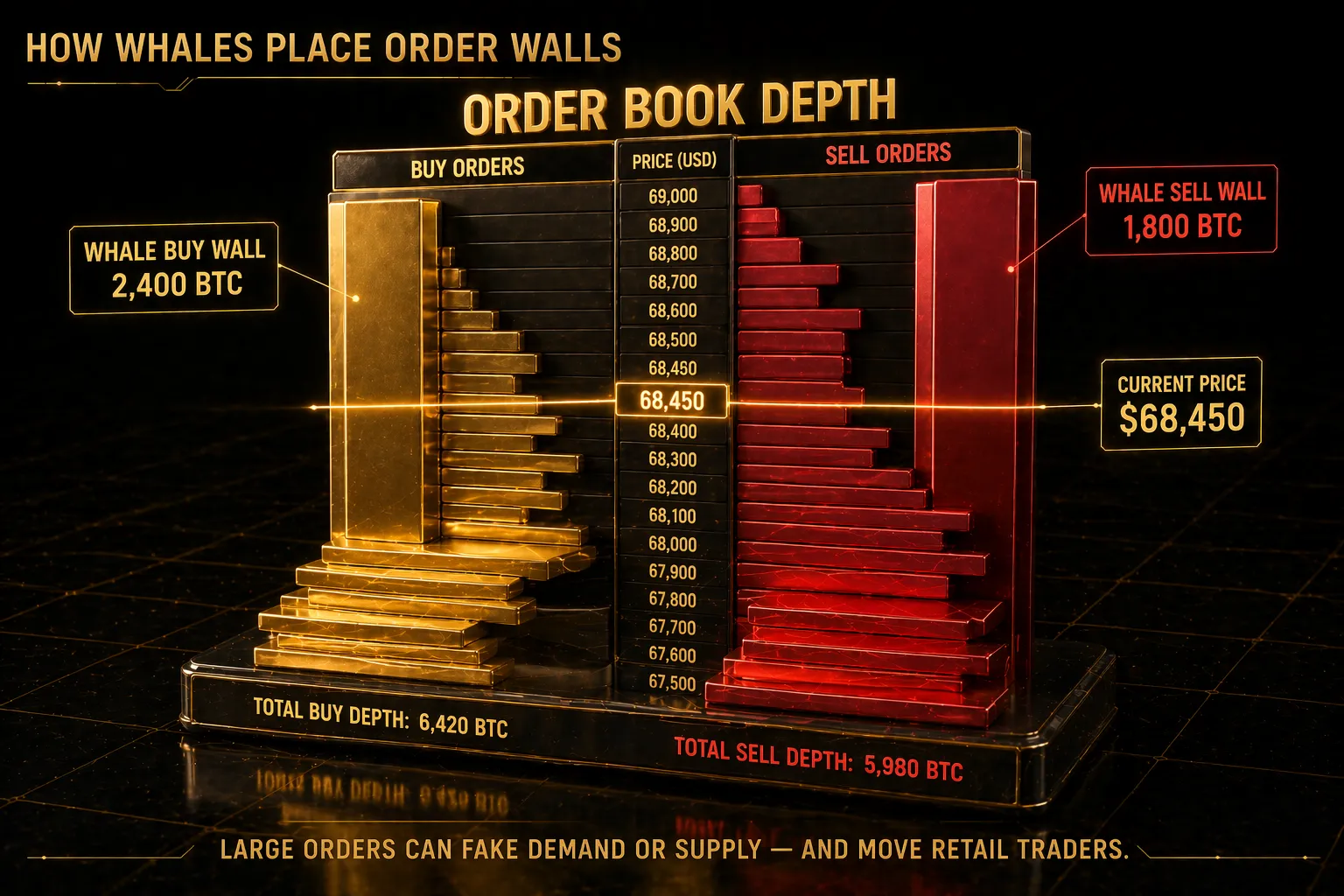
Order book walls — huge fake orders placed to manipulate where retail traders think price will go.
What is an order book wall?
A wall is an enormous buy or sell order at a specific price, much bigger than the surrounding orders. It looks like a wall rising up on the order book chart. Walls attract attention because they seem to show strong demand (buy wall) or strong supply (sell wall) at that level.
How the trick works:
A whale places a huge buy wall at, say, ₹60 lakh per Bitcoin when current price is ₹62 lakh. Retail traders see this wall and think: "there is a big buyer at ₹60 lakh, price cannot go below that". They start buying at ₹62 lakh, confident the wall will support the price.
Then, just before price actually touches ₹60 lakh, the whale removes the wall (cancels their order). Now there is nothing supporting the price. It drops through ₹60 lakh easily. Retail traders, who bought at ₹62 lakh expecting support, now face losses.
The whale might even buy the coins back at ₹58 lakh — cheaper than where they sold them earlier. The retail traders provided liquidity for the whale's game.
Sell walls work the opposite way. A whale places a massive sell order at a resistance level, making retail traders think "price will not break above this". Traders short the coin below the wall. Then the whale removes the wall, price shoots through the "resistance", shorts get stopped out, and the whale profits from a long position.
How to recognise fake walls:
- They appear suddenly. A wall that was not there 30 minutes ago, now appearing at a key price level, is suspicious.
- They disappear before being hit. Real conviction shows up as orders that get filled, not cancelled. If a wall vanishes just as price approaches, it was a fake.
- They are at psychologically important levels. Whales place fake walls at round numbers (₹60 lakh, ₹70 lakh) because retail traders watch those levels.
- They seem too clean. Real order flow is messy. Perfectly round, very large orders at specific levels are more likely to be manipulation.
What to do:
Do not trade based on order book walls alone. Trade based on actual price action, volume, and broader analysis. If a wall disappears before being hit, assume it was a trick — not genuine support or resistance.
Pump and dump — the oldest trick in the book
Pump and dump is the most famous manipulation scheme, and it is everywhere in crypto — especially in small altcoins.
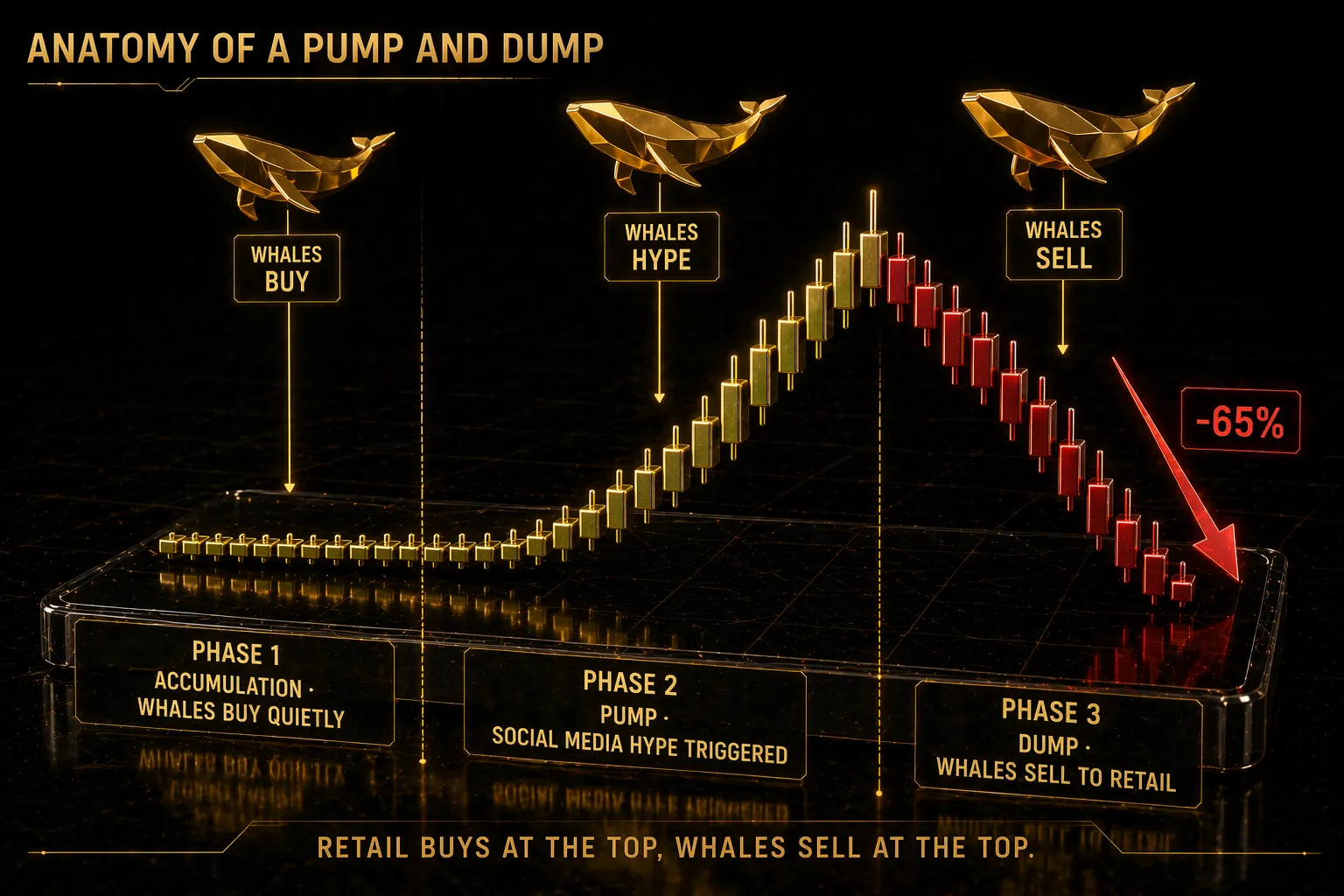
The three phases of every pump and dump — accumulation, pump, dump. Always the same pattern.
The three-phase pattern:
Phase 1 — Accumulation. A group of whales quietly buys a small, low-volume coin over several weeks. They spread their buying so it does not move the price too much. By the end, they own a large portion of the available supply. The coin is still unknown. Price is still low.
Phase 2 — Pump. The whales coordinate a publicity push. They pay crypto influencers on Twitter, YouTube, and Telegram to promote the coin. Paid articles appear. Twitter gets flooded with tweets claiming the coin is "the next 100x". Retail traders see the buzz and rush in. Whales also add some buying of their own to accelerate the price rise. Within days or weeks, the price can jump 300-1,000%. Everyone who got in early is celebrating.
Phase 3 — Dump. At the peak, while retail is still euphoric and buying, whales start selling their accumulated coins. They sell into the buying pressure. Price reaches its peak and stalls. Whales keep selling. Price starts dropping. Retail traders think it is a normal pullback and buy more. Whales keep selling. Price drops harder. Panic spreads. By the time retail realises what happened, prices are down 70-90% from the peak. Whales are long gone with their profits. Retail holds worthless coins.
Where pump and dumps happen most:
- Small low-volume altcoins (below top-200 by market cap). Less liquidity = easier to pump.
- New meme coins just after launch, before they have any real community.
- Coins in "trending" sections of crypto news sites. Once a coin trends, new money flows in — perfect for dumping on.
- Telegram "pump groups". These are public or private groups that openly coordinate pumps. They tell you the coin to buy at a certain time. By the time your order executes, the organisers have already bought. You buy from them. You become exit liquidity.
Warning signs you are being set up:
- A small coin with no news suddenly surges with heavy volume.
- Twitter and Telegram are flooded with promoters saying "this is the next moon".
- Price chart shows near-vertical rise with no pullbacks.
- Multiple influencers with similar scripts promoting the coin simultaneously.
- The coin is in someone's "pump group" announcement.
How to avoid:
Stick to coins in the top 50-100 by market cap that have been around for 2+ years. These are too liquid to be easily pumped and dumped. Never buy a coin just because it is rising fast and everyone is talking about it — that is often the top. Our market psychology guide goes deeper into why FOMO buying at the top is the most common retail mistake.
Wash trading — fake volume that fools you
Wash trading is when the same trader (or group of traders) buys and sells a coin to themselves, creating the illusion of high trading volume without actually changing anything. It is one of the sneakiest manipulation techniques because it is invisible to casual traders.
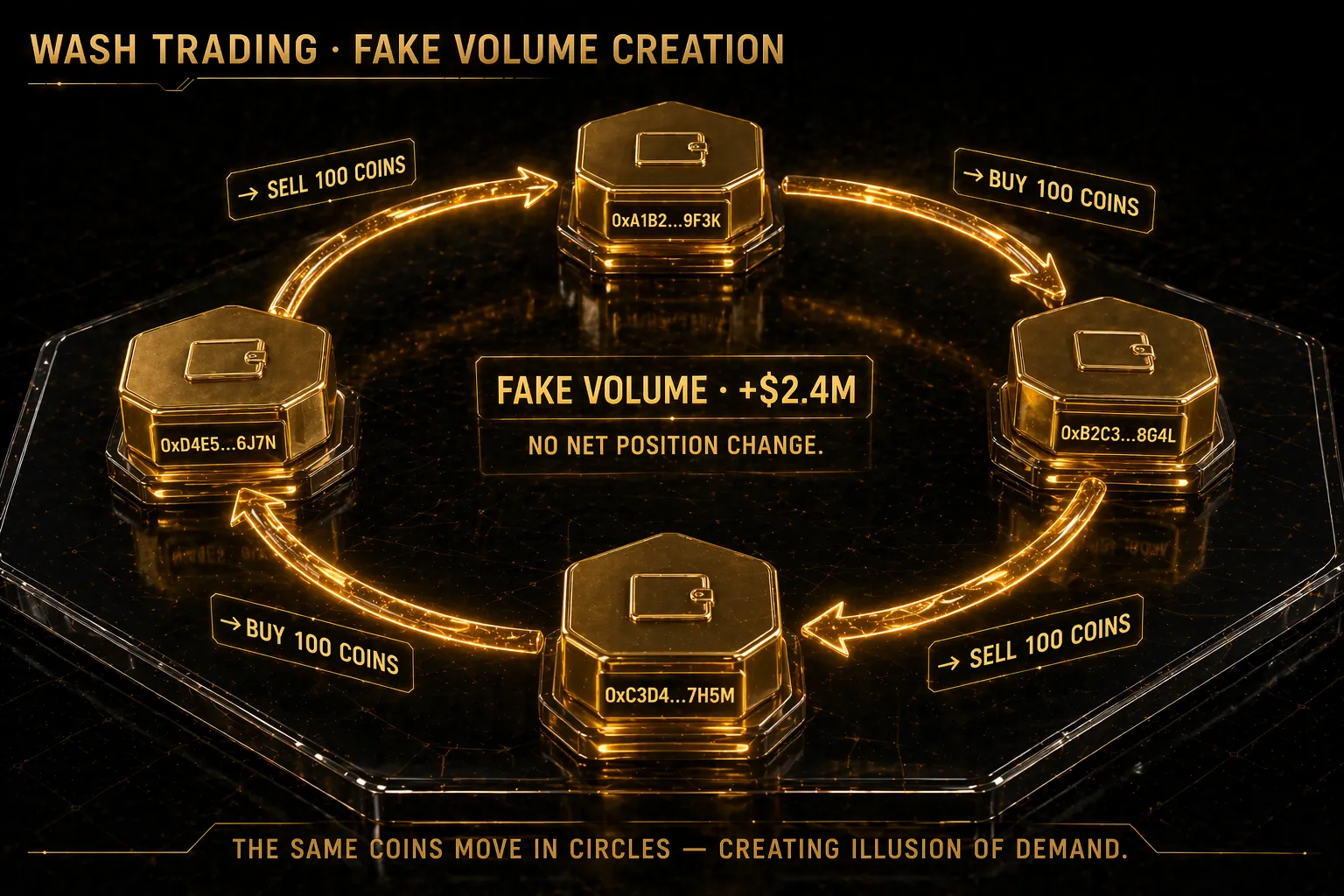
Wash trading creates fake volume by cycling coins between wallets a trader controls.
How it works:
Imagine a whale owns wallet A and wallet B. Wallet A places a sell order for 100 BTC at ₹60 lakh. At the same time, wallet B places a buy order for 100 BTC at ₹60 lakh. The orders match. Trading volume records "100 BTC traded at ₹60 lakh". But the whale has not actually changed their position — they just moved coins from their left pocket to their right pocket, minus exchange fees.
Now imagine this happens thousands of times, between multiple wallets the whale controls. The coin's trading volume looks massive. The coin appears highly liquid and popular. But almost none of it is real trading.
Why whales do it:
- To attract retail traders. Retail traders often pick coins with "high volume" thinking they are safer. Fake volume makes a shady coin look legitimate.
- To rank higher on exchange listings. Many exchanges rank coins by volume. Wash trading pushes a coin up the rankings, giving it more visibility.
- To manipulate price charts. Coordinated wash trading can create fake price moves that trigger retail traders' technical analysis signals.
- To inflate exchange metrics. Some small exchanges wash-trade their own volume to appear larger than they are. This attracts listings and users.
How widespread is wash trading?
Academic studies have estimated that in certain small altcoins, up to 70-90% of reported trading volume is wash trading. Even on many established exchanges, a significant fraction of volume in low-cap coins is fake. This is one of crypto's dirty secrets that most retail traders have no idea about.
How to spot likely wash trading:
- Uniform, regular trade sizes. Real trading is random — different sizes, different times. Wash trading often shows suspiciously uniform patterns.
- Volume does not match price action. High volume with tiny price movement is a red flag.
- Spread is wider than expected. If volume is "huge" but the bid-ask spread is wide, something is off.
- Volume is concentrated at suspicious times. Organic trading volume varies by hour and day. Wash trading often happens in bursts at specific times.
- Trading volume is much higher than market cap would suggest. A small coin with ₹50 crore market cap reporting ₹500 crore daily volume is almost certainly wash-traded.
What to do:
Stick to high-quality exchanges that actively police against wash trading (Binance, Coinbase, Kraken, large Indian exchanges). Avoid small unknown exchanges. For individual coins, prefer top-100 market cap coins where wash trading is harder to hide due to scrutiny. Independent data sources like CoinGecko offer "normalised volume" estimates that try to filter out wash trading — worth checking before trusting any coin's volume figure.
Stop-loss hunting explained
Stop-loss hunting is a specific form of short-term manipulation where whales deliberately push prices to trigger retail stop-losses, creating a cascade that gives them better entry prices.
Background — what is a stop-loss?
A stop-loss is an automatic sell order that triggers when price falls to a certain level, protecting you from further losses. Example: you buy Bitcoin at ₹60 lakh, set a stop-loss at ₹58 lakh. If price drops to ₹58 lakh, your coins are automatically sold to limit your loss to ₹2 lakh per BTC.
Stop-losses are essential for risk management. Every serious trader uses them. But there is a problem — everyone tends to place their stops at similar, predictable levels:
- Just below a recent support level.
- Just below round numbers (₹60 lakh, ₹70 lakh).
- Just below the lows of the last few candles.
- Just below key moving averages.
Whales know this. They can see (through order-flow analysis and on-chain data) roughly where retail stop-losses are clustered.
How the hunt works:
Say Bitcoin is trading at ₹62 lakh, and many retail stops are sitting just below a support at ₹60 lakh (so around ₹59.5 lakh). A whale who wants to accumulate Bitcoin cheaply will:
- Step 1. Place a series of sell orders to push price down to ₹59.9 lakh.
- Step 2. As price nears ₹60 lakh, other sellers join in (news sites report "Bitcoin breaking support", causing more selling).
- Step 3. Price pierces below ₹60 lakh, triggering the mass of retail stop-losses. All those stops become automatic market sells.
- Step 4. Price cascades down to ₹58 lakh as stops trigger each other in a chain reaction.
- Step 5. The whale, who was the original seller, now buys aggressively at ₹58 lakh — getting a huge position at a price no retail trader could believe just a day earlier.
- Step 6. Without the retail selling (they are all stopped out), price recovers back to ₹62 lakh or higher within days.
The retail traders who got stopped out at ₹58 lakh watch the price recover to ₹62 lakh. They feel betrayed. But they were just caught in a stop hunt.
How to protect yourself from stop hunts:
- Avoid obvious stop-loss levels. If everyone places stops at round numbers, do not place yours there. Place them at unusual levels like ₹59.42 lakh instead of ₹60 lakh.
- Use wider stops. If your stop-loss is 2% below entry, you are in the typical hunt zone. A 5-7% stop gives more room but requires a smaller position size to keep risk constant.
- Use mental stops instead of exchange stops for critical levels. Some experienced traders do not place exchange stops near obvious levels — they watch manually and execute if the move is clearly not a hunt. This requires discipline and is not recommended for beginners.
- Trade on higher timeframes. Stop hunts mostly target short-timeframe traders. If you are swing trading on the daily chart, your stops can be placed well below the noise of hourly hunts.
- Never trade with too much leverage. Leverage makes stops tighter and more vulnerable to hunts. See our leverage trading guide for why 90%+ of retail leveraged traders get wiped out by these very dynamics.
Stop hunting is hardest to avoid completely — it is a structural feature of how markets work. But understanding it helps you place stops more intelligently and react less emotionally when you get hunted.
How to spot whale activity in real-time
Most retail traders have no idea when whales are active. But the data is public — you just have to know where to look. Here are the signals you can watch for, all using free tools.
Signal 1 — Large on-chain transfers. The simplest signal. When a wallet moves 1,000+ BTC or 10,000+ ETH, it is a whale transaction. Follow Whale Alert on Twitter (@whale_alert) — it posts every major transfer in real time. Large movements to exchanges often precede selling. Large movements from exchanges often indicate accumulation.
Signal 2 — Exchange reserve changes. When coins flow into exchanges in large amounts, selling pressure is building. When they flow out, accumulation is happening. Tools like CryptoQuant and Glassnode show exchange reserve changes daily. Sharp, unusual changes often indicate whale activity. Our on-chain analysis guide covers this in detail.
Signal 3 — Sudden order book changes. If a large buy or sell wall appears suddenly and then disappears before being hit, it was probably a whale's fake order trying to manipulate sentiment. If a wall appears and is actually filled, it is more likely a real large order.
Signal 4 — Unusual volume spikes. When volume suddenly surges without obvious news reasons, whales are often active. Watch the 24-hour volume change on your coin. A 200% surge on a quiet day often precedes a larger move.
Signal 5 — Bitcoin dominance shifts. When money flows from small altcoins into Bitcoin (rising BTC dominance), whales are often de-risking. When it flows the opposite direction, they are taking on more risk — often late in bull cycles.
Signal 6 — Old coin movements. Coins that have not moved for years occasionally wake up. This usually means an old whale (or their heirs) is doing something — often selling. Glassnode tracks "coin days destroyed" which shows when old coins are being moved.
Signal 7 — Labelled wallet activity. Tools like Arkham Intelligence and Nansen label many major wallets (including known funds, trading firms, and individuals). You can follow specific wallets and get notifications when they trade. For example, you can follow MicroStrategy's wallet or a specific hedge fund's wallet.
Signal 8 — Derivatives open interest changes. When open interest on futures markets suddenly spikes or drops, large players are positioning. This often precedes big moves. CoinGlass provides free open interest data.
A practical weekly routine:
- Monday: Check Glassnode or CryptoQuant for exchange reserve trends over the last week.
- During the week: Follow Whale Alert on Twitter. Take note of large transfers.
- Before any big trade: Check IntoTheBlock's large holder flow for your coin, plus Fear and Greed Index.
- Monthly: Check Arkham/Nansen for changes in labelled whale wallets you follow.
15-30 minutes per week is enough to stay informed about whale activity. This alone puts you ahead of retail traders who watch only price charts.
How small traders can protect themselves
You cannot become a whale. You cannot outbid their capital. But you can refuse to be their exit liquidity. Here is how small traders protect themselves from whale manipulation.
Defence 1 — Stick to high-quality, established coins. Most manipulation happens in small low-cap coins where whales have enough relative power to move the market. Top-50 coins by market cap are much harder to manipulate because they have deep liquidity and many large players. Focus most of your portfolio (at least 70%) on established names like Bitcoin, Ethereum, and top-20 coins.
Defence 2 — Trade on higher timeframes. Most whale manipulation happens on short timeframes (minutes to hours). The daily and weekly charts filter out most of this noise. If you swing trade on the daily and avoid day-trading on the 5-minute chart, you dodge 90% of manipulation.
Defence 3 — Never chase pumps. A coin up 50% in a day is not "about to go to the moon" — it is usually already in the dump phase from a whale's perspective. Never buy based on recent sharp rises. If you missed the move, let it go. The market offers endless opportunities. Chasing pumps makes you exit liquidity.
Defence 4 — Avoid "hot" tips from Telegram, Twitter, YouTube. If a random influencer is promoting a coin heavily, ask yourself: why? They are probably being paid to pump, or they bought early and need retail to pump their bag. Real opportunities do not need heavy marketing. The more aggressive the hype, the higher the manipulation risk.
Defence 5 — Use dollar-cost averaging. Instead of trying to time entries, buy fixed small amounts at fixed intervals. This makes you less vulnerable to whale-manipulated price dips and rallies. Whales can manipulate short-term price, but they cannot manipulate your consistent monthly buying schedule. Our DCA guide covers this approach in depth.
Defence 6 — Place stop-losses at unusual levels. Not at round numbers. Not just below obvious support. Use levels that would not be targeted by a coordinated hunt. ₹59.47 lakh is a much better stop than ₹60 lakh.
Defence 7 — Limit leverage, or avoid it entirely. Leverage makes you vulnerable to every form of manipulation. A 5% stop hunt wipes out a 20x leveraged position. A 10% wash-traded fake move forces a stop on a 10x position. No leverage = much less vulnerability.
Defence 8 — Diversify across exchanges. If you trade on only one exchange, any manipulation targeting that exchange affects you fully. Spreading holdings across 2-3 reputable exchanges reduces this risk (though it increases complexity).
Defence 9 — Keep long-term coins in cold storage. Coins on exchanges can be moved by exchanges during extreme events. Your long-term holdings should be in a hardware wallet under your control. Exchange only what you actively trade.
KAVACH — Defence against manipulation and wipe-outs
KAVACH is our protective framework covering position sizing, stop-loss placement strategies, leverage discipline, and the anti-manipulation checklist that separates survivors from exit liquidity. If you trade crypto at all, understanding how you get set up is the first step to not getting caught.
Explore the Store →A final thought. Crypto markets are not fair. Whales have informational, capital, and structural advantages over retail. But retail traders also have an advantage whales do not have — time. Whales often have short-term pressure from investors and performance targets. You can hold a good coin for 5 years without reporting to anyone. That patience is something no amount of capital can replicate. Stay focused on the long game. Avoid being caught in the short-term traps. Over time, patient retail investors often do better than the whales trying to manipulate them.
Join our Telegram community where we discuss whale moves and manipulation patterns as they unfold. Our crypto education courses include a full module on market structure and manipulation defence. Be aware. Be patient. Be disciplined. That is how small traders win in the long run.
Frequently asked questions
How much Bitcoin do you need to own to be considered a whale?
The common definition is 1,000+ BTC (about ₹70-80 crore at 2025-26 prices). For Ethereum, 10,000+ ETH. For smaller altcoins, it depends on the coin — usually 1-5% of the total supply. These thresholds matter because at that size, a single wallet can significantly move market prices through normal buying or selling, let alone through deliberate manipulation.
Is whale manipulation in crypto illegal?
It depends on the specific action and jurisdiction. Pump and dumps on registered exchanges are generally illegal in most countries with securities laws, but enforcement in crypto is weak because of unclear regulations and cross-border complexity. Wash trading and stop hunting fall into grey areas. Regardless of legality, all these practices harm retail traders — which is why awareness and defensive strategies matter more than waiting for regulation.
Can I make money by following whale wallets?
Sometimes, with caution. Following known smart-money wallets through Arkham Intelligence or Nansen can provide useful signals — but with delays. By the time you see a trade and react, prices have often already moved. Also, some whale wallets trade based on private information you don't have, so copying them blindly is risky. Use whale tracking as one signal, not as a copy-trading strategy.
How do I know if a crypto pump is real or a manipulation setup?
Real pumps usually have multiple confirmation signals — genuine news, rising on-chain activity, broader market strength, and sustainable volume. Manipulated pumps show concentrated volume without obvious drivers, coordinated social media promotion, and sharp vertical price rises. If a small coin goes up 100% in a day with heavy Telegram hype and no real news, assume it is a manipulation — not a genuine move.
Which crypto coins are most vulnerable to whale manipulation?
Small low-volume coins below top-100 by market cap are most vulnerable. Newly launched coins in their first 3-6 months are extremely vulnerable. Meme coins with no real utility are often purely manipulation vehicles. Top-20 coins like Bitcoin, Ethereum, Solana, and BNB have enough liquidity and distribution to make large-scale manipulation much harder (though not impossible). For safety, stick mainly to top-50 coins as a beginner.
cRyPtO sMaRt is not registered with SEBI and does not provide investment advice. Crypto trading carries significant risk of capital loss. The strategies, examples, and opinions shared in this article are for educational purposes only. Always do your own research and consult a SEBI-registered financial advisor before investing real capital. Past performance does not guarantee future results.