
- What leverage actually is — cutting through the marketing
- Liquidation — the event you must design around
- Why 95% of retail leverage traders blow up
- The math of leverage that nobody shows you
- Position sizing — the survival skill
- How a single wick destroys a leveraged account
- The 8 rules of responsible leverage
- Building a real risk framework with KAVACH
- Frequently asked questions
What leverage actually is — cutting through the marketing
Leverage lets you control a position larger than your actual capital. If you have ₹10,000 and use 10x leverage, you control a ₹1,00,000 position. Every 1% move in the underlying asset produces a 10% move in your account. Upside and downside scale equally. Exchanges market leverage as a tool for amplifying gains. The statistic they don't put in the marketing is that the large majority of retail leverage traders lose their capital entirely within months.
Understand what leverage really is: it is a loan from the exchange, secured by your deposit. When your position moves against you enough that the loss approaches your deposit, the exchange closes your position automatically to recover the loan. This is liquidation. You lose your deposit entirely and are still short nothing — the exchange is whole. This is the asymmetry you must internalise before you ever place a leveraged trade.
Indian exchanges offer leverage up to 20x on major coins, with some international platforms offering 100x. Retail traders typically use 10-20x without fully understanding what that means for their liquidation distance. Institutions using leverage trade at 1.5x to 3x — not because they can't use more, but because they understand what we'll cover next.
Before we continue: this guide is not telling you never to use leverage. Used surgically by experienced traders with large accounts, leverage is a precision tool. But for 95% of retail crypto traders, leverage accelerates losses far more than it accelerates gains. The honest framing beats the marketing every time.
Liquidation — the event you must design around
Every leveraged position has a liquidation price — the price level at which your losses equal your deposit and the exchange force-closes your position. This is the single most important number in your trading life when you use leverage, and most beginners cannot calculate it off the top of their head for any of their open positions. That is the first problem.
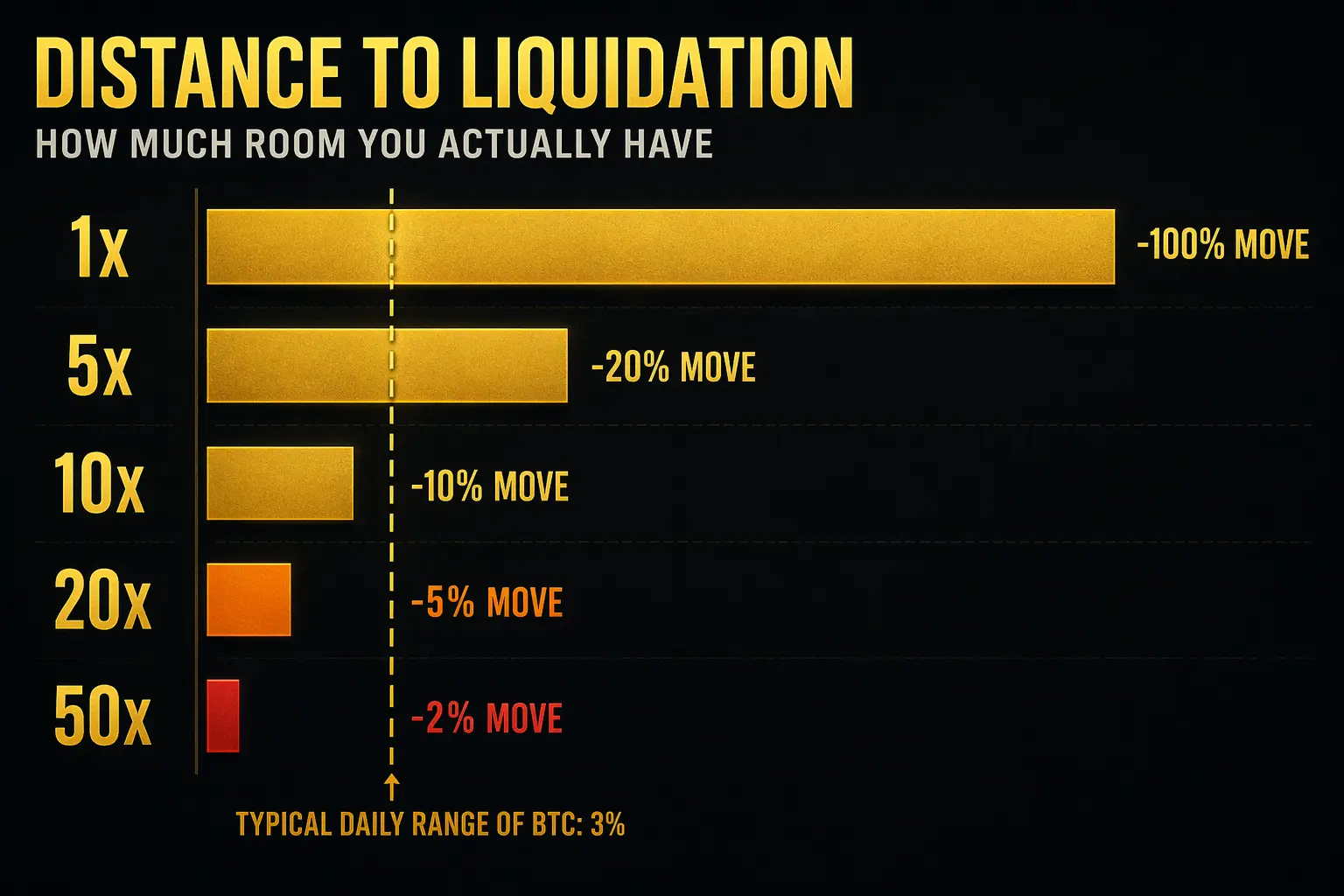
How close liquidation really is at each leverage level — with 50x, a normal 2% move finishes you.
The liquidation formula (simplified, ignoring maintenance margin):
- For a long position: liquidation price = entry price × (1 - 1/leverage)
- For a short position: liquidation price = entry price × (1 + 1/leverage)
Let's make this concrete. Bitcoin at ₹75,00,000. You go long with 10x leverage. Your liquidation price is ₹67,50,000 — a 10% drop wipes you out. Bitcoin's average daily range in 2025 was 2.5-3.5%. In other words, your liquidation is roughly 3 average daily moves away. A single news event, a single whale liquidation cascade, a single thin-liquidity weekend wick — any of these can traverse 10% in minutes.
Push leverage to 20x and liquidation sits 5% from entry. That's inside one average daily range. Push to 50x and liquidation sits 2% from entry — often inside a single candle's range. This is why high leverage is not a strategy, it's a countdown timer to zero.
Why 95% of retail leverage traders blow up
The failure rate isn't because retail traders lack intelligence. It's because they underestimate the combination of five structural forces working against them.
Force 1 — Overconfidence after early wins. A new leverage trader's first few trades often work. This is because crypto spends more time trending than ranging, and any direction-biased trade has 50%+ win rate during trends. Early wins create false confidence that leads to bigger positions at higher leverage — right before the first adverse move wipes everything.
Force 2 — Mental accounting of leverage as "free money". Beginners treat 10x leverage as 10x reward without internalising 10x risk. They size positions based on what they could earn, not what they could lose. Professional traders do the opposite — they size based on what they must survive.
Force 3 — Emotion-driven stop-loss placement. At 10x leverage, a -5% move on the asset is a -50% move on the account. Most retail traders cannot psychologically tolerate a 50% drawdown, so they either (a) don't set stops, hoping to avoid the pain, or (b) widen stops repeatedly as price approaches. Both behaviours convert manageable losses into catastrophic losses.
Force 4 — Funding fee drain. Perpetual futures charge a funding fee every 8 hours. During strong trends, the popular side pays 0.01-0.1% every 8 hours just to hold the position. Over a week, a 10x leveraged position held on the popular side can lose 2-5% to funding alone, before any adverse price action.
Force 5 — Cascades and wicks. Crypto markets have cascading liquidations. One large liquidation triggers the next, which triggers the next, creating violent single-candle moves that blow through retail stop-losses before they can execute. We cover this in depth in the next section.
Take all five forces together and you get a structural setup where the retail leverage trader is fighting against the exchange's interest (they want you liquidated), market structure (cascades hunt leverage), and their own psychology (early wins create overconfidence). 95% lose. The 5% who profit do so by respecting these forces, not by being smarter.
The math of leverage that nobody shows you
Exchanges show you "up to 100x" in big bold text. They don't show you the math of what that means for survival. Let's fix that.
Scenario 1: ₹50,000 account, 10x leverage, standard trade.
- Position size: ₹5,00,000 (10x the account)
- Entry: BTC at ₹75,00,000
- Liquidation: ₹67,50,000 (-10%)
- Break-even move required (after 0.06% round-trip fees + 0.03% funding per 8 hours): 0.1% just to cover costs
- If BTC drops 5% overnight (not uncommon): account drops to ₹25,000 — a 50% loss from a 5% move
- If BTC drops 10% in a cascade: account goes to zero. Full liquidation.
Scenario 2: Same ₹50,000, 2x leverage, same entry.
- Position size: ₹1,00,000 (2x the account)
- Liquidation: ₹37,50,000 (-50%)
- Break-even move: 0.06%
- If BTC drops 5%: account drops to ₹45,000 — only 10% loss
- If BTC drops 10%: account drops to ₹40,000 — 20% loss, still very recoverable
- BTC would need to drop 50% (which happens roughly once per cycle, over weeks) to liquidate
The lesson. Going from 10x to 2x reduces your liquidation risk by 5x while reducing your upside by 5x — but the critical difference is that you actually survive to participate in the upside. In the 10x scenario, most traders are liquidated before they see meaningful gains. In the 2x scenario, you stay alive long enough to let compounding work.
Over 100 trades, the 2x trader who survives every normal drawdown beats the 10x trader who compounds gains faster but blows up at trade 38. Survival first, returns second. That's not a cliché — it's the math.
Position sizing — the survival skill
The single skill that separates surviving leverage traders from blown-up leverage traders is position sizing — deciding how big each trade should be relative to your account, risk tolerance, and stop-loss distance. Get this right and leverage becomes a precision tool. Get it wrong and leverage becomes a wealth destroyer.
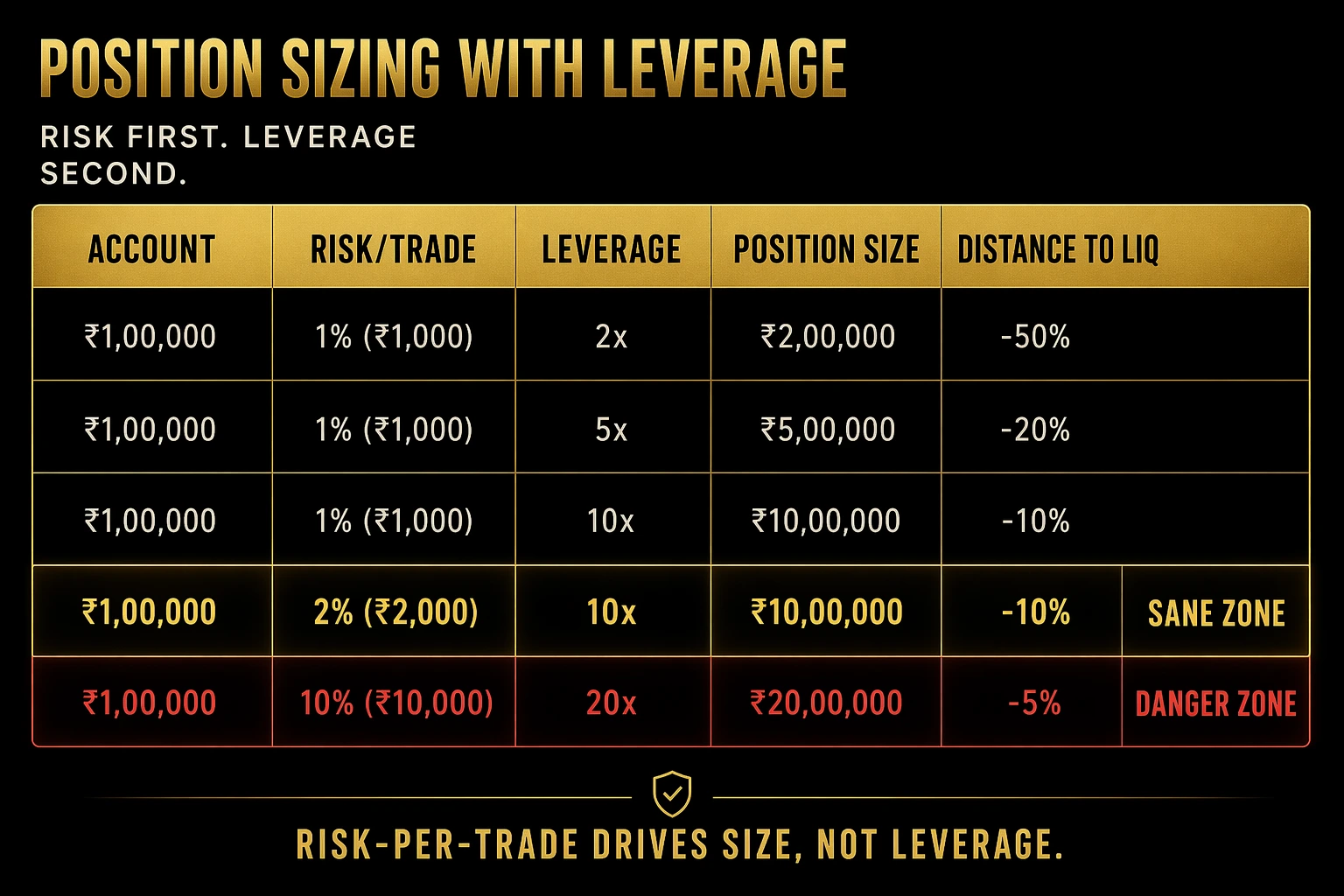
Risk-first sizing — the 'sane zone' at moderate leverage, the 'danger zone' where retail accounts die.
The golden rule: risk drives size, leverage follows. Never choose leverage first. Choose the risk per trade first, then calculate what leverage allows that risk given your stop distance.
The formula:
- Decide risk per trade: 1% for most traders, 2% for experienced, never more than 3%.
- Decide stop-loss distance: typically 2-5% from entry for a swing setup, 0.5-1% for intraday.
- Calculate position size: risk amount ÷ (stop distance × price).
- Calculate leverage needed: position size ÷ account margin.
- If leverage needed exceeds 3x, either widen your stop or reduce your risk per trade.
Worked example. ₹2,00,000 account. Risk per trade: 2% = ₹4,000. BTC at ₹75,00,000, stop at ₹71,25,000 (5% away). Position size in BTC: ₹4,000 ÷ (₹3,75,000 per BTC loss) = 0.0107 BTC. Position value: ₹80,250. Leverage needed: ₹80,250 ÷ ₹2,00,000 = 0.4x. You don't even need leverage for this trade — a spot position is fine.
Most retail traders do this backwards. They decide "10x" first, then pick a position size that uses all their margin, then set a stop based on feel. The result is random risk per trade, oversized losses, and eventual liquidation. Flip the sequence. Risk first. Size second. Leverage only if needed.
How a single wick destroys a leveraged account
Crypto is uniquely hostile to over-leveraged positions because of liquidation cascades — chains of forced selling where one liquidation triggers the next through thin order books, creating violent single-candle moves that blow past any retail stop-loss.
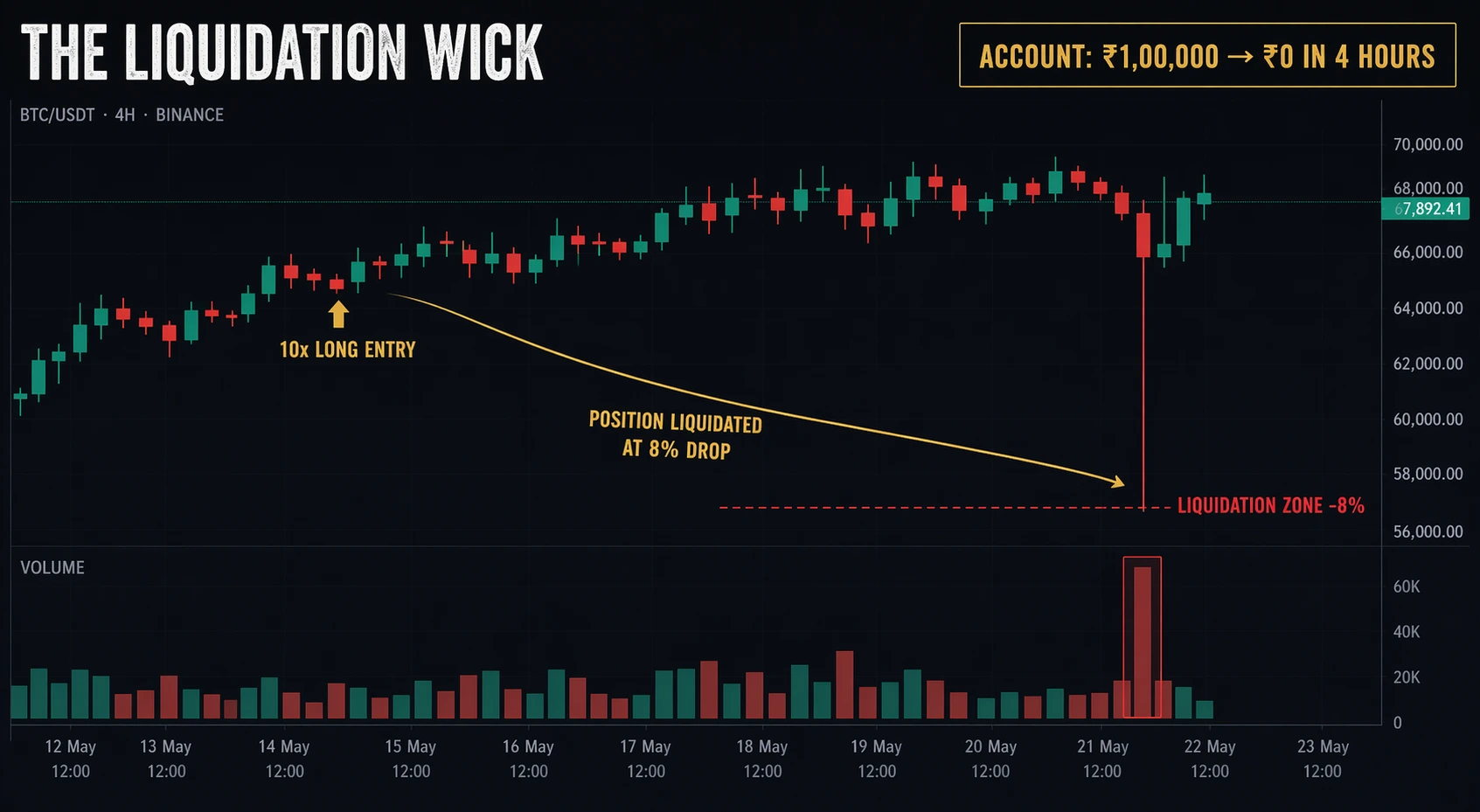
The cruelty of the liquidation wick — one candle liquidates your 10x long, then price recovers to the entry within an hour.
Anatomy of a cascade. Price drifts lower. The first wave of leveraged longs hits their liquidation prices. Exchanges force-sell their positions at market. This forced selling pushes price lower still, triggering the next cluster of liquidation levels. And the next. Within 5-15 minutes, price has fallen 8-15% through thin order book depth. Then it typically recovers most of the move over the following hour as buyers step in at the flushed-out levels.
Why your stop-loss doesn't save you. At 10x leverage with a 5% stop, a cascade that drops 8% in three minutes runs through your stop and potentially triggers your liquidation before your stop order is executed at the intended price. Slippage during cascades routinely exceeds 2-3%. Your ₹50,000 account can go to ₹0 during a cascade that would cost a 2x trader only ₹8,000.
When cascades happen. Low-liquidity hours (3-6 AM IST), weekends, news shocks (regulatory announcements, exchange hacks), and during extreme funding rate imbalances where one side is dangerously crowded. A leveraged trader should understand these conditions and either reduce size or close positions before entering them.
The cruel irony. After a cascade liquidates you, price usually recovers to your entry level within 1-4 hours. The market was right about your direction — you just didn't have the sizing to survive the wick. This is the experience that destroys more leverage traders than any other. For more on how whales and market makers deliberately engineer these events, read our guide on whale manipulation.
The 8 rules of responsible leverage
If after reading all of the above you still want to use leverage, these are the rules I would not violate. I have personally broken most of them at some point in my five years and paid the tuition. Learn them here instead.
Rule 1 — Maximum 3x leverage for swing trades, 5x for intraday, never above 10x. The diminishing returns of higher leverage are not worth the liquidation exposure. 3x swing trading is genuinely useful. 50x is suicide.
Rule 2 — Risk per trade maximum 2% of account. This is non-negotiable. At 1% you can survive 10 losses in a row. At 5% you are one bad week from a crippling drawdown.
Rule 3 — Stop-loss set at the exchange, never mental. Mental stops fail during the exact moments you need them — fast markets, cascades, emotional moments.
Rule 4 — Never add to losers. Averaging down on a leveraged losing position multiplies your exposure to the exact move that's already going against you. This one habit has blown up more accounts than any other.
Rule 5 — Reduce leverage during high-volatility events. Before CPI, FOMC, or major news — either close positions or reduce size to spot-only. The expected move during these events often exceeds normal volatility by 3-5x.
Rule 6 — Monitor funding rates. When funding turns extreme (above 0.05% per 8 hours) on your side, the crowd is crowded. Either take profit or flip. Extreme funding nearly always precedes a flush of the crowded side.
Rule 7 — Daily drawdown limit 5%, stop trading for the week. If you lose 5% in a day, stop. No trading for 48 hours minimum. Emotional trading after a 5% loss is how small losses become ruin.
Rule 8 — Keep spot holdings separate from leveraged capital. Your long-term conviction holdings should never be in the same account as your leverage margin. Separate wallets. Separate exchanges if possible. This prevents cascades on leveraged trades from touching your long-term stack.
Building a real risk framework with KAVACH
Position sizing, liquidation awareness, and drawdown discipline aren't instincts — they are frameworks that must be built deliberately. Most retail traders try to build them after their first blow-up, which is an expensive way to learn. A better approach is to adopt a risk framework before you ever place a leveraged trade.
KAVACH — Risk protection for leveraged traders
KAVACH is a risk-first framework designed around the exact failure modes that destroy retail leverage traders — position sizing calculators, liquidation distance checks, daily drawdown limits, funding rate alerts, and recovery protocols after loss streaks. If you're trading with leverage, the risk framework matters more than any specific entry signal.
Explore the Store →Leverage is not inherently bad. Used by a disciplined trader at 2-3x with proper sizing, it allows capital-efficient expression of high-conviction setups. The problem is not leverage — it's retail traders using leverage without the risk framework required to survive its natural volatility. For a contrast in style, a pure DCA approach described in our dollar-cost averaging guide requires no leverage at all and has produced better long-term results for most retail investors in any case.
If you're earlier in your trading journey, consider building consistent profitability in swing trading spot positions first. Once you have 100+ journaled trades with positive expectancy, then — and only then — add leverage at 2x. Scale up only after surviving a full market cycle without a blow-up. This is the path most long-term traders actually took, even if their current online persona implies they always used 10x. They almost never did.
Our trading courses include a risk-management module with position-sizing worksheets and survival frameworks. The community on Telegram has ongoing discussions about leverage best practices and shares real blow-up stories — painful reading that might save you from the same fate.
Frequently asked questions
What is the safest leverage to use in crypto?
1x-3x maximum for most retail traders. At 2x, your liquidation sits 50% away from entry — far enough that normal crypto volatility cannot wipe you out. Many experienced traders use only 1x (spot) for years before ever touching leverage. There is no award for using high leverage; there is only faster ruin for those who do.
How does liquidation actually work on crypto exchanges?
When your position's loss approaches your deposited margin, the exchange automatically force-closes your position at market price to protect itself from your unpaid loan. You lose your entire deposit for that position. The liquidation price is calculated based on your entry, leverage, and the exchange's maintenance margin. Most exchanges also charge a liquidation fee of 0.5-1% as a final insult.
Can I use leverage on an Indian crypto exchange?
Yes, leverage trading is available on major Indian exchanges, typically up to 10x-20x on majors. Tax treatment follows the same 30% flat rate as spot trading, with 1% TDS on sells. Futures positions create additional reporting complexity at year-end. Before using leverage on any Indian exchange, verify the maintenance margin requirements and liquidation mechanism — they vary across platforms.
Why do funding rates matter for leveraged traders?
Perpetual futures charge a funding fee every 8 hours, paid from the popular side to the unpopular side. During strong trends, funding can cost the crowded side 0.05-0.1% every 8 hours — meaning a crowded long position loses 2-3% per week to funding alone, before price action. Extreme funding rates also signal overcrowding and often precede violent flushes. Monitoring funding is non-negotiable for leveraged traders.
Is it possible to be a consistently profitable leverage trader?
Yes, but it's rare and requires strict discipline. The traders who succeed long-term use 2-3x leverage maximum, risk 1-2% per trade, use exchange-set stop-losses, monitor funding, avoid high-volatility news windows, and treat leverage as a tool rather than a shortcut. They also survived a period of losses before becoming consistent. Overnight leverage success is a myth sold by influencers; sustainable leverage profitability is a craft built over years.
cRyPtO sMaRt is not registered with SEBI and does not provide investment advice. Crypto trading carries significant risk of capital loss. The strategies, examples, and opinions shared in this article are for educational purposes only. Always do your own research and consult a SEBI-registered financial advisor before investing real capital. Past performance does not guarantee future results.