- What is a crypto portfolio, in simple words?
- Why most beginners lose money on random coins
- Position sizing — the rule that saves accounts
- Allocation — how much of each type of coin
- The risk pyramid explained
- Diversification — smart, not random
- Rebalancing — when and how to adjust
- Common portfolio mistakes to avoid
- Frequently asked questions
What is a crypto portfolio, in simple words?
A portfolio is just the collection of all your investments, looked at as one group. Your crypto portfolio is the total mix of all the crypto you own — Bitcoin, Ethereum, stablecoins, altcoins, everything.
Most beginners never think of their crypto as a portfolio. They just buy one coin, then another, then another, based on tips or hype. This is called "random buying". It feels fine when prices are rising. It breaks badly when prices fall.
Portfolio management is about treating your crypto investments as a system. Like a well-planned wardrobe. You do not just buy clothes randomly. You have formal shirts for office. Casual shirts for weekends. A good coat for winter. Jeans for comfort. Each item has a role.
A well-built crypto portfolio works the same way. Each coin has a role:
- Bitcoin — the foundation, the safest part of your crypto.
- Ethereum — exposure to the largest smart contract platform.
- Stablecoins — ready cash to buy during crashes.
- Selected altcoins — higher risk but higher potential returns.
- ₹ (INR) reserve — money outside crypto for emergencies.
Good portfolio management answers three simple questions:
- How much money total should I put into crypto?
- How should I split that money between different coins?
- When should I adjust my holdings?
Once you can answer these three questions with a clear plan, you are already ahead of 80% of retail traders. You will make calmer decisions. You will survive bad markets. And when good markets come, you will be ready to benefit.
This guide walks through each step in simple language. No maths degree needed. No complicated theory. Just practical rules that work.
Why most beginners lose money on random coins
Let me describe a typical beginner. Maybe this sounds familiar.
You heard about crypto from a friend in 2024. You put ₹10,000 in Bitcoin. It went up. You felt smart. You put another ₹20,000 in some small coin someone recommended on Telegram. That also went up at first, then crashed. You bought more because "the dip is a chance". It kept falling. Now you have another ₹15,000 in a third coin recommended by a YouTube influencer. Total: ₹45,000 spread across 3 random coins, and you are unsure what to do.
This is not a portfolio. This is a collection of bets. There is no plan. No system. No way to measure if you are doing well. And no protection when things go bad.
Here is what typically happens to traders without a portfolio plan:
- They put too much money into one "sure winner". When it drops 70%, they cannot recover.
- They chase every hot coin they see. Their portfolio becomes a random pile of 20+ altcoins, most of which become worthless.
- They never take profits. When prices rise, they hold for more. When prices fall, they panic-sell near the bottom.
- They have no stablecoins. When the market crashes and opportunities appear, they cannot buy because they have no cash ready.
- They put money into crypto that they actually needed for real-life expenses. When an emergency comes, they have to sell at a bad price.
All of these problems are solved by one simple thing: a written portfolio plan. It does not have to be complex. A single page is enough. But the difference it makes is massive.
Compare the random trader above with someone who has a plan. The planned trader knows: "I will put 5% of my net worth in crypto. Within that, 40% Bitcoin, 30% Ethereum, 20% stablecoins, 10% altcoins. I will rebalance every 3 months. I will never buy a coin that is not in my top-20 by market cap." This person will make fewer big winners, but they will avoid the big wipe-outs that destroy the random trader's account.
A plan does not need to be perfect. Any plan, even a simple one, beats no plan. The goal of this guide is to give you a simple plan you can start with today.
Position sizing — the rule that saves accounts
Before we talk about which coins to buy, we need to talk about how much. This is called position sizing, and it is the single most important skill in all of investing.
Here is the first rule, and it is the most important rule in this entire guide:
Never invest more money in crypto than you can afford to lose completely.
Read that again. Crypto is a high-risk asset. Prices can drop 70-85% in a bear market. Individual altcoins can go to zero. If losing all the money you put into crypto would seriously damage your life, you have too much money in crypto. Period.
How much of your net worth should be in crypto?
A simple guideline:
- Beginner (first 1 year): 2-5% of total net worth in crypto.
- Intermediate (2-3 years experience): 5-15% of net worth.
- Advanced (5+ years experience): Up to 25% of net worth (still not more, even for believers).
For most Indian readers, this means: if you have ₹5 lakh total net worth (savings + investments + emergency fund), a sensible crypto allocation as a beginner is ₹10,000-25,000 (2-5%).
This will feel small. It is small on purpose. Your goal as a beginner is not to "get rich fast" — it is to learn without losing money you cannot afford to lose. If your small allocation grows, you can increase it over time. If it fails, you did not ruin your life.
The second rule of position sizing — within your crypto portfolio:
Never put more than 30% of your crypto money in any single coin other than Bitcoin or Ethereum. And never put more than 10% in any small altcoin.
Example: you have ₹50,000 in crypto. Maximum ₹15,000 in any single altcoin. Maximum ₹5,000 in any small altcoin (below top-50 by market cap). Bitcoin and Ethereum can be larger slices because they are more established.
This sounds restrictive. It is. That is the point. Limits keep you safe from the biggest mistake beginners make — putting too much in one "hot tip" that ends up going to zero.
Allocation — how much of each type of coin
Now that you know the total amount to commit, let us talk about allocation — how to split that money between different types of crypto.
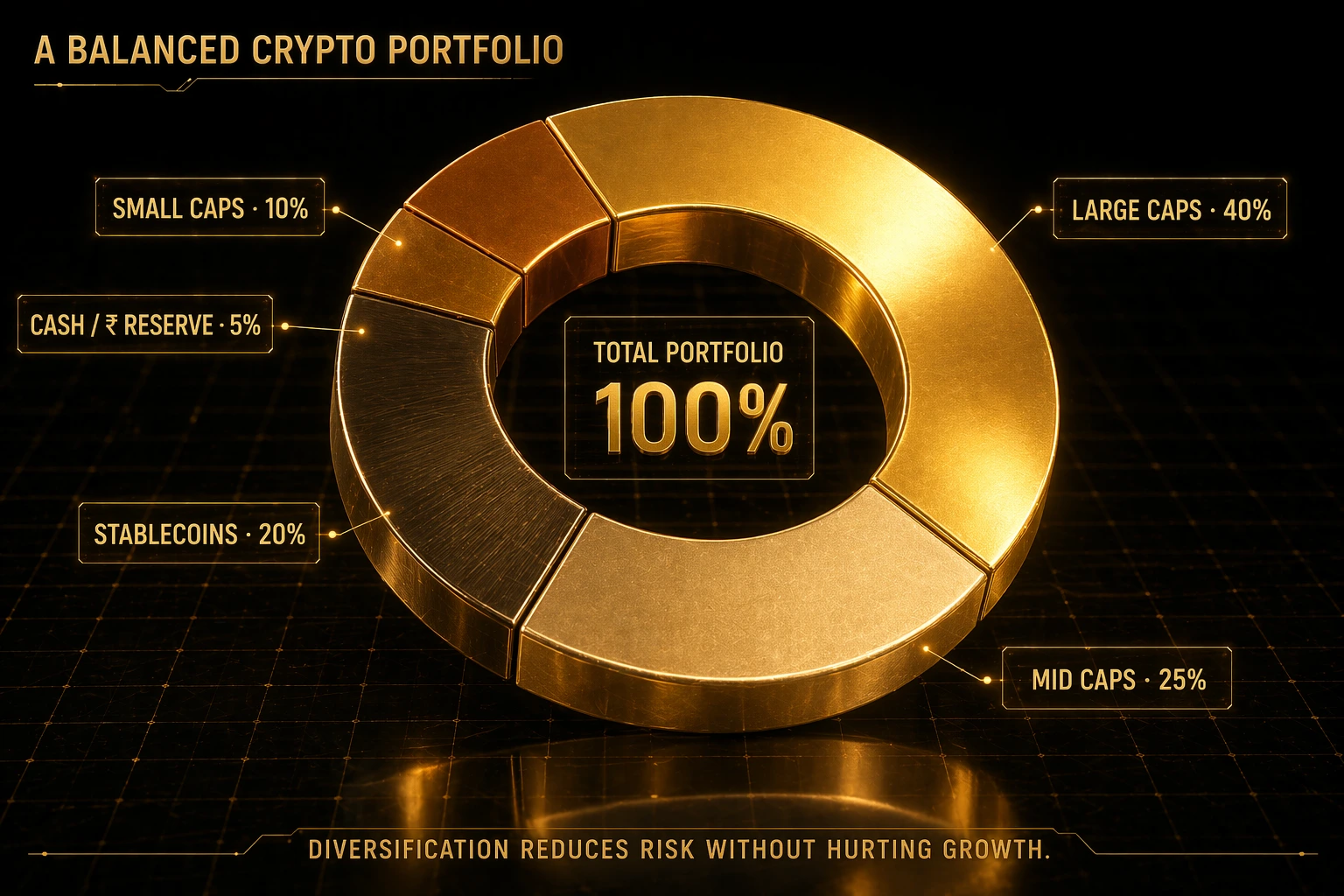
A sample balanced portfolio — each slice has a purpose, from stability to growth to dry powder.
Crypto coins can be grouped into categories based on size and role. Here is a simple beginner-friendly allocation that works across market cycles.
Large caps (40-50% of your crypto) — Bitcoin and Ethereum. These are the two biggest, most established, most liquid cryptos. They are still risky (can drop 70% in bear markets) but they survive and recover. The bulk of a beginner's portfolio should be here. Of the 40-50%, a common split is 25-30% Bitcoin and 15-20% Ethereum.
Stablecoins (20-30%) — USDC, USDT. These are your dry powder. They stay at $1 each, so they do not gain or lose value with market moves. But during crashes, they let you buy other coins at low prices. Without stablecoins, you cannot take advantage of bargains. Many beginners skip this allocation and then regret it when the market offers cheap prices and they have no cash.
Mid caps (15-20%) — large established altcoins. These are top-20 coins by market cap (excluding BTC and ETH). Examples: Solana, BNB, XRP, Cardano, Polkadot, Chainlink. These have real teams, real usage, and multi-year track records. They offer bigger potential gains than BTC/ETH, but also bigger drops. Spread this allocation across 3-5 coins, not all in one.
Small caps (5-10%) — selected smaller altcoins. Top-50 to top-100 coins with genuine fundamentals. These are high-risk, high-reward. Many of them will fail. But the winners can be multi-baggers. Only invest money here you can afford to lose entirely. Spread across 3-5 coins maximum.
Speculation / memecoins (0-5%) — optional. If you want to bet on the latest hot coin, limit it strictly. This portion of your portfolio should be treated as pure gambling money. Expect to lose most of it.
A simple sample portfolio for a ₹50,000 beginner allocation:
- Bitcoin: ₹15,000 (30%)
- Ethereum: ₹10,000 (20%)
- Stablecoins (USDC): ₹12,500 (25%)
- Solana: ₹4,000 (8%)
- BNB or Cardano: ₹3,500 (7%)
- Two small-cap altcoins: ₹5,000 (10% total)
This is just one example. Adjust based on your risk tolerance. More conservative beginners can lean toward 50% BTC + 30% stablecoins + less altcoin exposure. More aggressive ones might tilt toward 30% BTC + 30% ETH + more altcoins. The important thing is that you have a plan, and the percentages add up to 100%.
The risk pyramid explained
A good way to think about portfolio structure is as a pyramid. The bigger the base, the more stable the pyramid. The smaller the top, the less damage it causes if it falls.
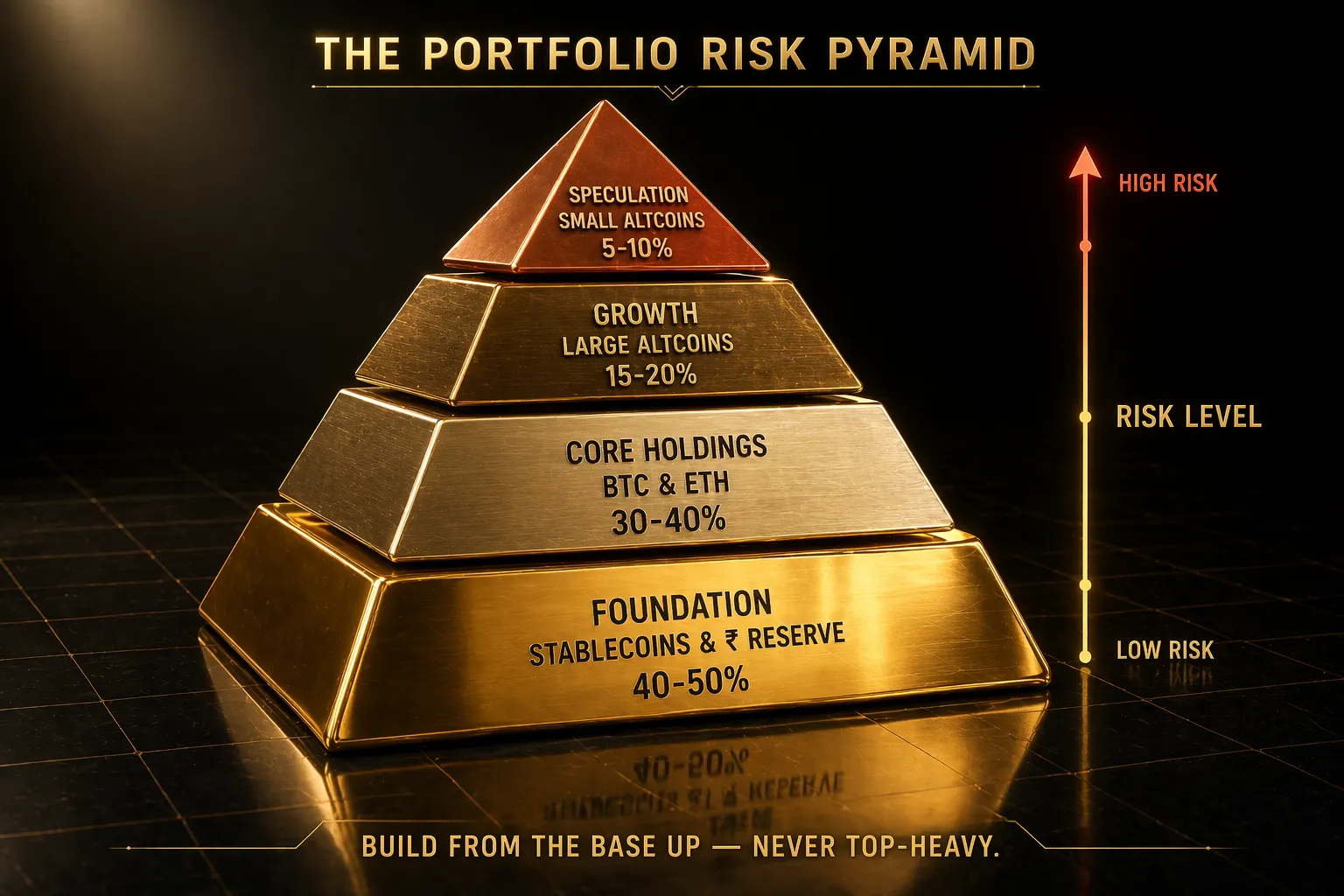
The risk pyramid — build wealth from the base up, never from the top down.
Base of the pyramid (largest, safest) — ₹ reserve and stablecoins. This is your foundation. It includes your emergency fund in a savings account or fixed deposit, plus stablecoins within your crypto portfolio. This money does not grow fast, but it does not vanish either. In a crisis, this is what keeps you from being forced to sell everything at the worst price.
Second tier — core crypto holdings. Bitcoin and Ethereum. These are the most established cryptos. They can still drop 50-70% in a bear market, but they have always recovered over multi-year cycles. They form the middle of your pyramid — bigger than the risky altcoins, smaller than your safe base.
Third tier — large altcoins. Top-50 established projects with real teams and usage. These offer higher growth potential than BTC/ETH, but also higher risk. Some will fail. This tier is smaller than your core.
Top of the pyramid (smallest, riskiest) — speculative bets. Small altcoins, new projects, meme coins. These can go to zero easily. They can also 10x if you pick right. This is the smallest slice. Only money you can afford to lose completely belongs here.
Why this structure matters:
Imagine two portfolios, each ₹1 lakh total, during a 60% bear market.
Portfolio A (inverted pyramid — top-heavy): 70% small altcoins, 20% ETH, 10% BTC, 0% stablecoins. In the bear market, small altcoins drop 80-95% on average. BTC and ETH drop 70%. The portfolio goes from ₹1 lakh to around ₹15,000-20,000. A devastating 80%+ loss.
Portfolio B (proper pyramid): 25% stablecoins, 30% BTC, 20% ETH, 15% large altcoins, 10% small altcoins. Stablecoins stay at ₹25,000. BTC drops to ₹9,000 from ₹30,000. ETH drops to ₹6,000 from ₹20,000. Altcoins drop hard but are small. Total: about ₹50,000-55,000. A painful 45-50% loss — but still enough to rebuild from.
The difference? Portfolio B had structure. Portfolio A was all top, no base. When storms came, Portfolio B survived. Portfolio A was destroyed.
Build your pyramid from the base up. Never chase gains at the top until your base is secure. Understanding cycles also helps you know when the base matters most — read our market cycles guide for the bigger picture on when to emphasise the base versus the top.
Diversification — smart, not random
You have probably heard the saying: "Don't put all your eggs in one basket." That is diversification in plain English. But in crypto, many beginners do it wrong.
Bad diversification: Buying 20 random altcoins you saw on Twitter because "more coins = more safety". This is not diversification — it is just chaos. Most of those coins will have similar risk profiles (they all go up together, and all crash together). You have 20 different lottery tickets, not 20 different businesses.
Good diversification: Owning coins that serve different roles and react differently to different conditions. This means thinking about categories:
- Store of value: Bitcoin is the main one. Digital gold.
- Smart contract platforms: Ethereum, Solana, Cardano. Different approaches to the same idea.
- Stablecoins: USDC, USDT. These are stable regardless of market direction.
- Layer-2 scaling solutions: Arbitrum, Optimism, Polygon. Tied to Ethereum's success.
- DeFi protocols: Aave, Uniswap. Revenue-generating projects.
- Oracles and infrastructure: Chainlink, others. They power many other projects.
By holding coins from different categories, you protect yourself from category-specific failures. If DeFi has a bad year, your store-of-value (BTC) and infrastructure holdings might still do well.
How many coins should you hold?
For a beginner: 5-10 coins is enough. For a more experienced trader: 10-15 at most. If you have more than 15 coins, you cannot possibly keep track of all of them properly. You are just collecting tickets, not managing a portfolio.
Rules for picking each coin:
- It must be in the top-100 by market cap (for safety).
- It must have existed for at least 2 years (survived at least one bear market).
- It must have a real team you can research (not anonymous).
- It must have real users or clear utility (not just hype).
- You must be able to explain in one sentence why you own it.
If a coin fails any of these checks, do not buy it — no matter how much your friend is pumping it. Our tokenomics guide walks through how to evaluate a coin's fundamentals in detail.
Diversification outside crypto. Do not forget — crypto should only be a small part of your total investments. Indian investors should also have stocks, mutual funds, fixed deposits, and emergency cash. True diversification crosses asset classes, not just coins. Our crypto vs mutual funds comparison helps you think about this balance.
Rebalancing — when and how to adjust
Once you have built a portfolio, you need to maintain it. This is called rebalancing. It is simple but very powerful.
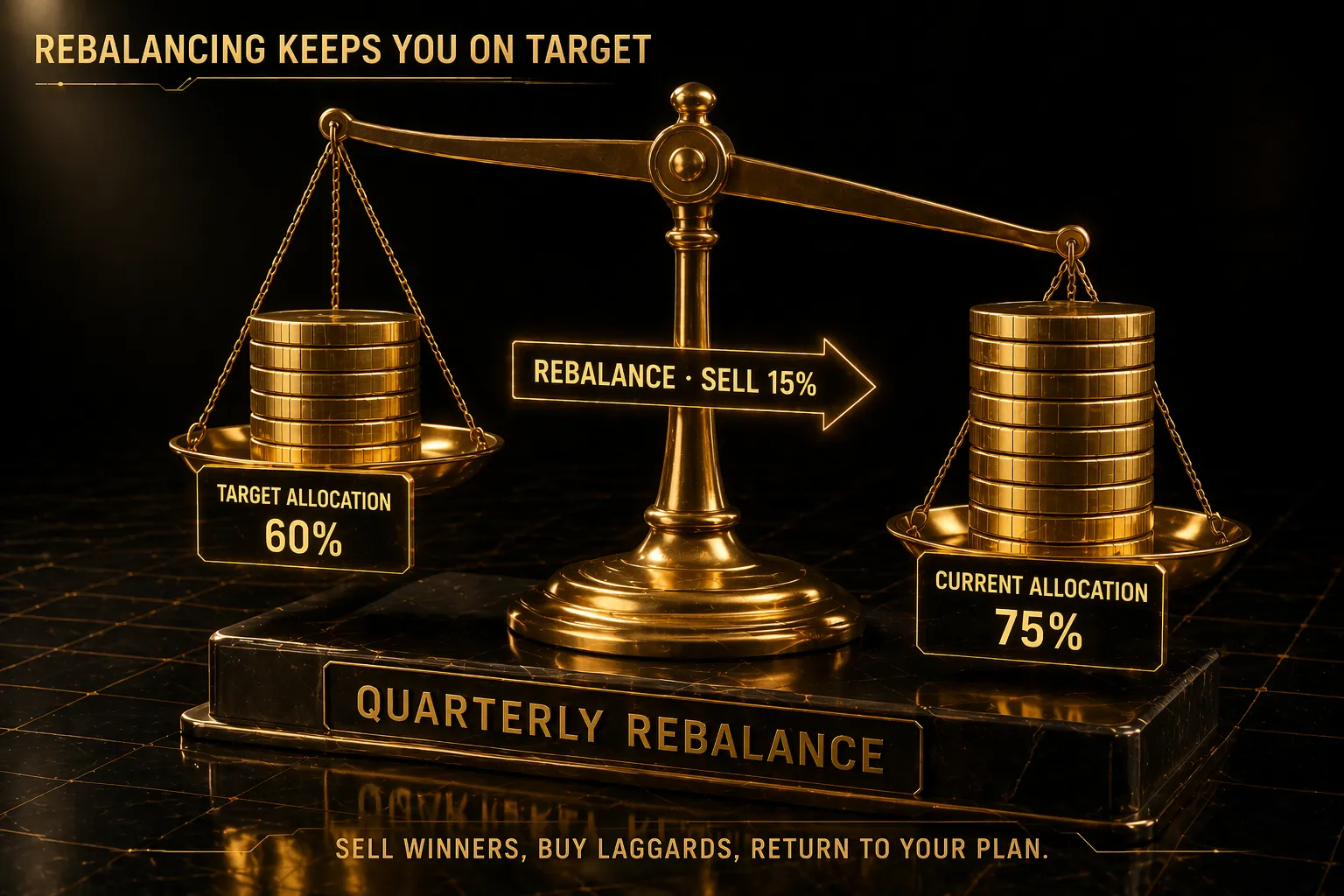
Rebalancing — selling a bit of what grew and buying a bit of what lagged keeps your plan on track.
Here is the problem rebalancing solves. Say you start with 30% Bitcoin, 20% Ethereum, 25% stablecoins, 25% altcoins. Perfect — by your plan. Then six months later, Bitcoin has doubled and altcoins have tripled. Now your portfolio is 35% Bitcoin, 15% Ethereum, 15% stablecoins, 35% altcoins. You are suddenly much more aggressive than you planned to be. Your risk has quietly grown.
Rebalancing means selling some of what has grown and buying some of what has lagged to return to your original target percentages. In the example above, you would sell some altcoins and some Bitcoin, and use the money to buy more Ethereum and stablecoins.
Why rebalancing works:
- It forces you to sell high (the assets that went up) and buy low (the assets that lagged). This is exactly what beginners fail to do emotionally.
- It keeps your risk level constant. Without rebalancing, a growing altcoin position can quietly become 60% of your portfolio, exposing you to huge losses if it crashes.
- It takes emotion out of selling. You are not deciding when to take profits — your rule is doing it automatically.
When to rebalance:
Option 1 — Time-based (recommended for beginners). Rebalance every 3 months or 6 months. Simple. Pick a date (say, the first Saturday of every quarter). Check your percentages. Adjust to target. Done. This approach is low-effort and works well.
Option 2 — Threshold-based. Rebalance whenever any category moves more than a certain amount from target (say, 5 percentage points). So if your target is 30% Bitcoin and it becomes 36%, rebalance immediately. This is more active but catches big moves faster.
Option 3 — Combination. Rebalance on schedule, but also check mid-quarter if any category has moved dramatically.
What to watch out for:
1. Taxes. In India, every crypto sale triggers a 30% tax on profits and a 1% TDS. Frequent rebalancing means more tax events. Keep rebalancing simple — every 3-6 months is usually optimal. Read our crypto tax guide to understand the costs before you rebalance too often.
2. Fees. Every trade has an exchange fee. Rebalancing too often eats into returns. Once or twice a year is fine for most beginners.
3. Overdoing it. You do not need to rebalance to the exact percent. Getting within a few percentage points is enough. Trying to hit exact numbers is stressful and unnecessary.
4. Emotional resistance. Selling a winner feels bad. "What if it keeps going up?" It might. But it might also drop. Rebalancing is about discipline, not prediction.
If you combine rebalancing with dollar-cost averaging (regular small buys), your portfolio grows steadily through all market conditions. This is how professional portfolio managers beat random traders over time — not by being smarter, but by being disciplined.
Common portfolio mistakes to avoid
Almost every beginner makes the same portfolio mistakes. Learning these in advance can save you years of losses.
Mistake 1 — Investing money you cannot afford to lose. The biggest mistake. Never put rent money, tuition fees, or emergency savings into crypto. If your crypto amount would hurt your life to lose, you have too much in crypto.
Mistake 2 — No stablecoin allocation. Many beginners skip stablecoins completely. Then when a crash happens and great buying opportunities appear, they have no dry powder. Always keep 20-30% in stablecoins — this is not wasted money, it is optional buying power.
Mistake 3 — Too many coins. Owning 20-30 different altcoins is not diversification. It is chaos. You cannot research or monitor that many. Stick to 5-10 coins for beginners, 10-15 for intermediates.
Mistake 4 — All-in on one altcoin. Concentrating 50% of your crypto in one small altcoin based on a tip is gambling, not investing. No single altcoin should be more than 10-20% of your portfolio unless it is BTC or ETH.
Mistake 5 — Never taking profits. Holding through entire cycles (called "diamond hands") sounds tough but costs money. When BTC runs from ₹20 lakh to ₹70 lakh, take some profits along the way. Not all — but some. You can always re-enter at lower prices. Our Fear and Greed Index guide shows you good times to take partial profits.
Mistake 6 — Using leverage on portfolio positions. Leverage (borrowing to invest more) multiplies both gains and losses. On long-term portfolio positions, it is a terrible idea. A normal 30% correction can wipe out a leveraged position. Our leverage trading guide explains why 90%+ of retail leverage traders lose money.
Mistake 7 — Rebalancing too often. Every trade in India costs 30% tax on profits and 1% TDS. Rebalancing monthly turns those taxes into portfolio drag. Quarterly or semi-annually is the sweet spot.
Mistake 8 — Ignoring the portfolio for months. The opposite of over-trading. Some beginners buy coins and then forget about them for years. Meanwhile, the market changed, coins failed, weights drifted. Check your portfolio at least once a month. Rebalance at least every 6 months.
Mistake 9 — Comparing your portfolio to others on social media. Someone always has bigger gains. Someone always picked the latest 100x coin. Your portfolio is not a competition. A boring portfolio that steadily grows beats an exciting one that occasionally blows up.
Mistake 10 — Not writing down your plan. If your plan exists only in your head, it will bend every time emotions hit. Write it on paper. Put it somewhere visible. "30% BTC, 20% ETH, 25% USDC, 15% alts, 10% speculation. Rebalance first Saturday of each quarter." That one-line plan, if followed, beats most advanced strategies.
KAVACH — Portfolio discipline that survives bear markets
KAVACH is our capital protection framework covering position sizing, allocation targets, rebalancing rules, and the risk-management discipline that separates long-term investors from wipe-out traders. If you are serious about crypto wealth, the defensive foundation matters more than any single trade.
Explore the Store →A final thought. Portfolio management is not exciting. There are no "secret signals" or "100x picks". It is boring discipline applied consistently over years. But this boring discipline is exactly what separates the 5% who build real crypto wealth from the 95% who lose money over time.
Your portfolio is a system. Build it on purpose. Protect its base. Let the winners grow. Rebalance regularly. Take profits at cycle peaks. Repeat for 2-3 cycles. At the end, you will own something real — not just stories of what you almost made.
Join our Telegram community where members share portfolio ideas and get feedback in a supportive space. Our crypto courses include portfolio construction modules with templates you can adapt. Start with a simple plan. Follow it. Adjust over time. That is the whole secret.
Frequently asked questions
How much money should a beginner put into a crypto portfolio?
Start with 2-5% of your total net worth. For someone with ₹5 lakh net worth, that means ₹10,000-25,000 in crypto. This will feel small — that is intentional. Your goal in year 1 is to learn without risking money you cannot afford to lose. Scale up gradually only after you have experienced a full cycle and understand your own emotional responses to big drops.
What is a good portfolio allocation for a crypto beginner in 2026?
A sensible beginner allocation: 30% Bitcoin, 20% Ethereum, 25% stablecoins (USDC/USDT), 15% large altcoins (3-5 top-20 coins), 10% small altcoins (2-3 top-100 coins). This gives stability from the BTC/ETH/stablecoin base, growth potential from altcoins, and buying power from stablecoins when crashes create bargains. Adjust percentages to your personal risk tolerance.
How often should I rebalance my crypto portfolio?
Every 3 to 6 months for most beginners. Pick a fixed date (for example, the first Saturday of each quarter) and check if your percentages have drifted from target. Rebalance if any category has moved more than 5 percentage points. Avoid rebalancing monthly — Indian crypto tax of 30% on gains plus 1% TDS makes frequent rebalancing very expensive.
Should I include stablecoins in my crypto portfolio?
Yes. Allocating 20-30% to stablecoins (USDC or USDT) is one of the most overlooked but important beginner decisions. Stablecoins are your 'dry powder' — they stay at $1 when markets crash, giving you buying power when great coins become cheap. Without stablecoins, crashes just mean pain. With them, crashes mean opportunities.
How many different coins should I hold in a crypto portfolio?
5-10 coins for beginners, 10-15 for intermediate investors. Holding more than 15 coins is not diversification — it is just chaos because you cannot properly research or monitor that many. Quality beats quantity: five well-chosen coins from different categories (store of value, smart contract platform, stablecoin, large altcoin, small altcoin) beat twenty random picks.
cRyPtO sMaRt is not registered with SEBI and does not provide investment advice. Crypto trading carries significant risk of capital loss. The strategies, examples, and opinions shared in this article are for educational purposes only. Always do your own research and consult a SEBI-registered financial advisor before investing real capital. Past performance does not guarantee future results.