
- Why crypto has more scams than regular finance
- The six most common crypto scams in 2026
- Eight red flags that should make you walk away
- Rug pulls explained — the hardest scam to spot
- Phishing — how attackers steal your wallet
- How to check if a project is real or fake
- What to do if you have been scammed
- Safe habits that protect you for life
- Frequently asked questions
Why crypto has more scams than regular finance
If you have been in crypto for more than a few months, you probably already know someone who lost money to a scam. Maybe it was a "guaranteed 2% daily profit" scheme that stopped paying. Maybe it was a fake Binance support email that stole their login. Maybe a "girl" on Instagram convinced them to invest in a fake platform.
The hard truth is that crypto has much more fraud than traditional finance. There are three reasons for this.
Reason 1 — Transactions cannot be reversed. If you get tricked into sending a bank transfer, sometimes the bank can reverse it. If you send crypto to a scammer, it is gone forever. No bank to call. No chargeback. No complaint cell. This permanence is what makes scammers love crypto.
Reason 2 — Weak regulation. Traditional finance has decades of regulation, customer protection laws, and licensed professionals. Crypto is much newer. In India, the rules are still being written. This gap creates opportunity for people who want to steal.
Reason 3 — Most users are new and eager. Many crypto users joined in the last 2-3 years. They saw stories of people making huge profits. They want to replicate that success. Scammers know this. They create schemes that promise exactly what new users are hoping for — easy, fast, guaranteed returns.
According to various Indian cybercrime reports, thousands of crores of rupees are lost to crypto fraud in India every year. The victims are not stupid. They are often educated people with real jobs and real savings. Scammers are professionals. They know how to manipulate emotions. They build fake websites that look exactly like real ones. They create fake communities full of fake testimonials.
The only real defence is knowledge. Once you learn the patterns, you see the scams everywhere. You will never fall for them. This guide walks through every major scam type you will encounter, how to spot them, and what to do if you are already affected. Read it fully. It might be the most useful 15 minutes you spend in crypto.
The six most common crypto scams in 2026
Almost every crypto scam you will encounter falls into one of six categories. Once you learn the pattern, you can spot them instantly.
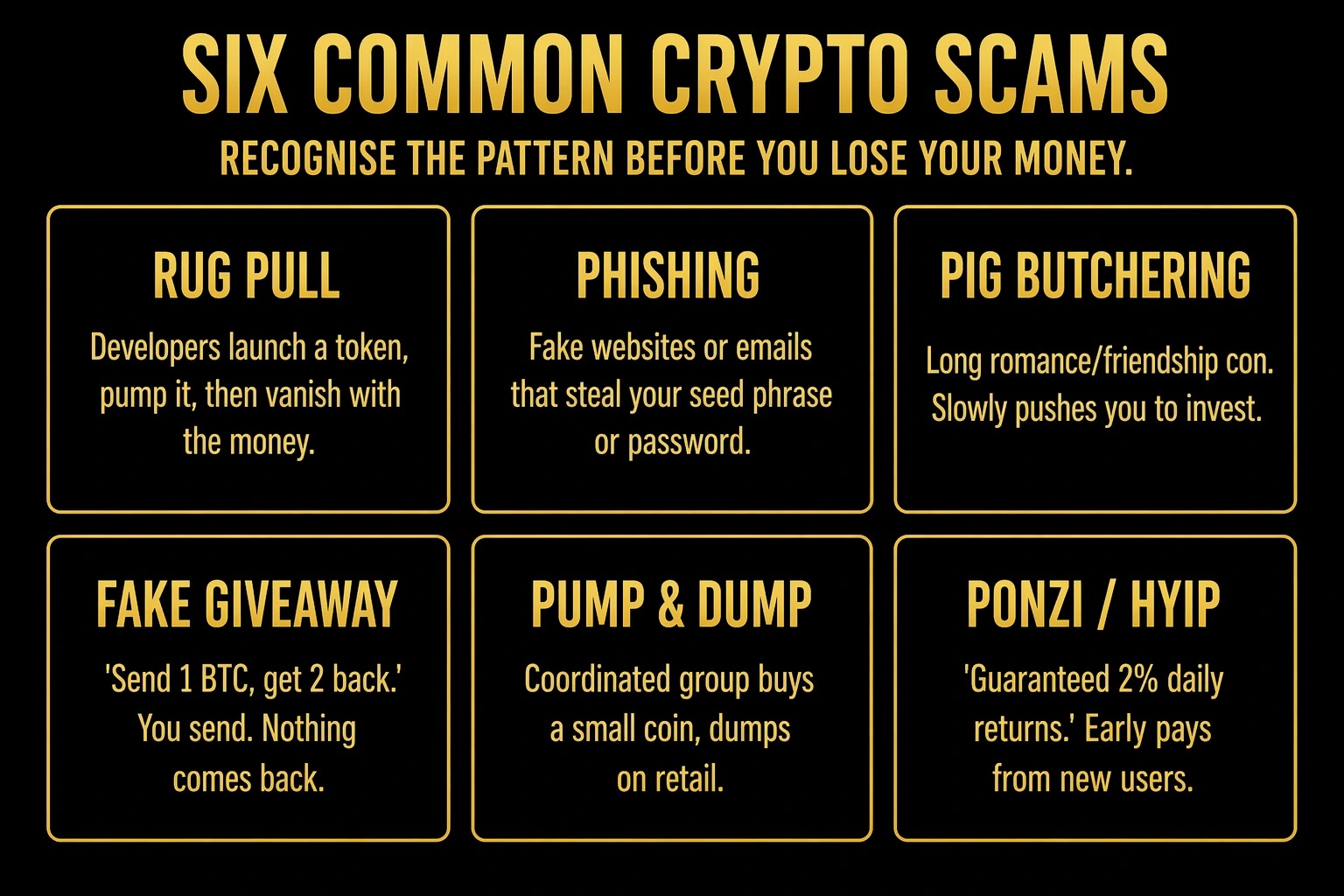
The six scam patterns you will meet in crypto — learn the patterns once, avoid them forever.
1. Rug Pull. A team launches a new crypto token. They build hype through social media and paid influencers. The price rises quickly. Then one day, the team sells all their tokens and disappears with the money. The token price crashes to near zero. Investors are left holding worthless coins. This is the most common new-token scam.
2. Phishing. Scammers send fake emails, messages, or create fake websites that look like real crypto services. When you enter your password or seed phrase, they capture it and drain your wallet. Common targets: fake exchange login pages, fake MetaMask extensions, fake "support" emails asking you to "verify your account".
3. Pig Butchering. This is a long-term con. It usually starts with a message from a stranger on WhatsApp, Instagram, or a dating app. They build a friendship or even a romance over weeks. Slowly, they introduce the topic of "their crypto trading platform that is making them lots of money". They encourage you to try it. You invest a small amount. It shows fake profits. You invest more. Eventually, when you try to withdraw, the platform blocks you or demands impossible fees. The "friend" disappears. The name comes from fattening the pig before slaughter — building trust before stealing.
4. Fake Giveaway. "Elon Musk is giving away free Bitcoin! Send 1 BTC to this address and receive 2 BTC back!" These scams are on Twitter, YouTube livestreams (often with hacked accounts), and Telegram. Of course, you send the 1 BTC and receive nothing back. No legitimate company or person gives away crypto for sending them crypto. Ever.
5. Pump and Dump. A group of coordinated traders buys a small, thinly-traded coin quietly. Then they heavily promote it on social media, WhatsApp groups, and paid signal services. New buyers rush in, pushing the price up 200-500%. The coordinators sell everything at the top. The price crashes. New buyers are left with huge losses. This happens constantly with small altcoins.
6. Ponzi Scheme / HYIP. "Guaranteed 2% daily returns!" "Our AI bot earns 30% per month, guaranteed!" These schemes pay early investors using money from new investors. For a while, early users receive real returns. Word spreads. More money flows in. Then one day, new investments slow down. The scheme collapses. Most people lose everything. If you see the word "guaranteed" anywhere in a crypto investment pitch, run.
We will cover how to specifically identify each of these in the next sections. But first, let us learn the general red flags that apply to almost every scam.
Eight red flags that should make you walk away
Most scams share common warning signs. If you see any 2 or more of these red flags in a crypto opportunity, walk away. Do not investigate further. Do not send any money. Just walk away.
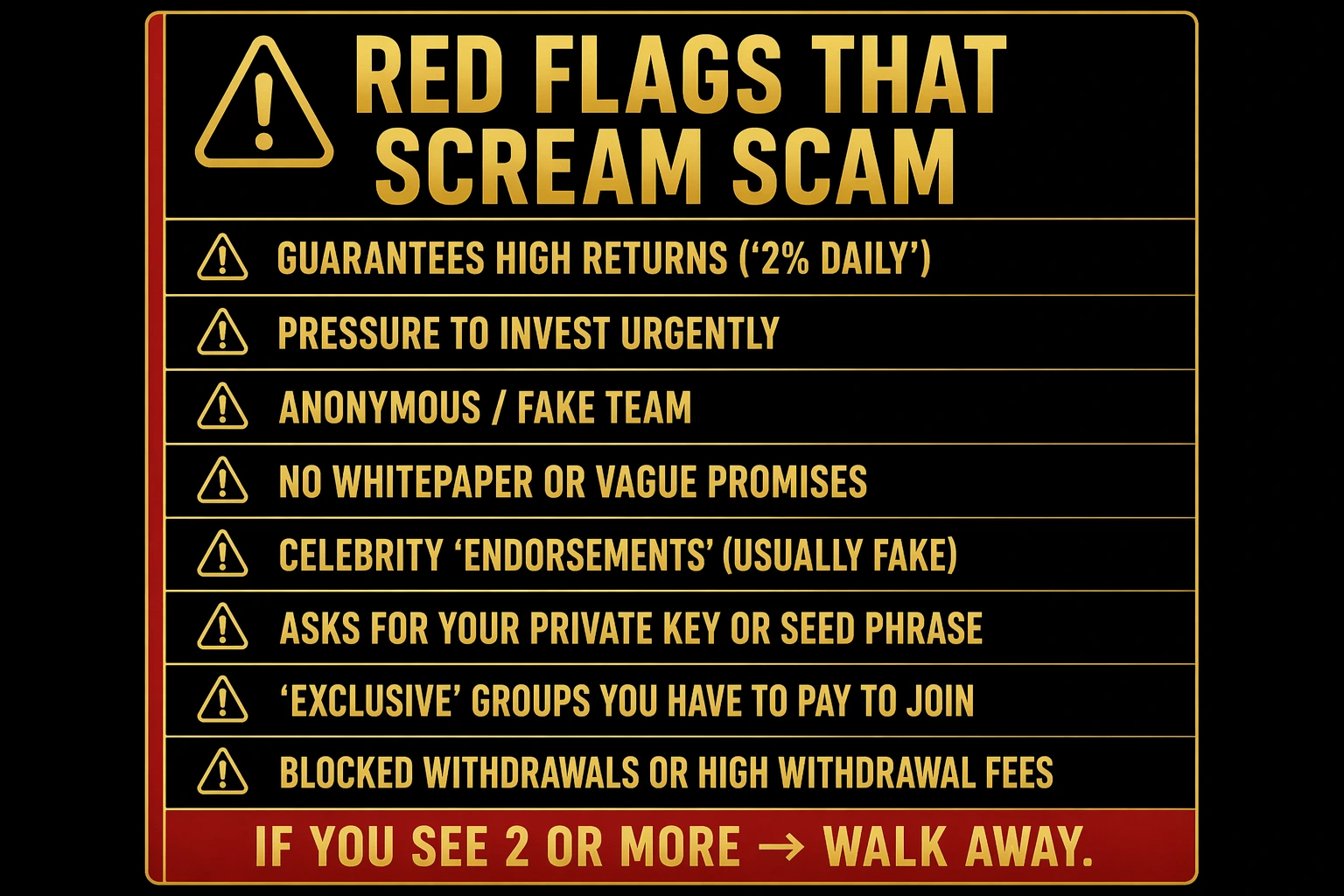
The eight red flags — two or more means walk away without further discussion.
🚩 Red Flag 1 — Guaranteed high returns. "Earn 2% per day!" "Guaranteed 20% per month!" In real investing, nothing is guaranteed. Bitcoin itself has lost 80% of its value multiple times. Anyone promising guaranteed returns is lying. Fact: Warren Buffett, one of the greatest investors alive, averages about 20% per year. Anyone promising 20% per month is either a fraud or will eventually become one.
🚩 Red Flag 2 — Pressure to invest urgently. "Limited time offer!" "Only 10 slots left!" "Price increases in 24 hours!" Real investments do not vanish overnight. Pressure is a manipulation tool. If you feel rushed, that is the exact moment to slow down.
🚩 Red Flag 3 — Anonymous or fake team. Every legitimate crypto project has real, verifiable team members with real LinkedIn profiles, real backgrounds, and real accountability. If the team is anonymous or uses obvious stock photos, the risk of a scam is enormous. Anonymous teams can disappear with your money and face no consequences.
🚩 Red Flag 4 — No whitepaper or vague promises. A whitepaper is a technical document explaining how a crypto project works. Real projects have detailed whitepapers. Scam projects either have no whitepaper, or they have a short document full of vague promises like "we will revolutionise finance" without any technical details.
🚩 Red Flag 5 — Celebrity endorsements (usually fake). Real celebrities occasionally endorse real crypto projects (though that is also risky). But many "endorsements" you see are completely fake — stolen videos, photoshopped images, fake quotes. Always verify directly from the celebrity's real verified account.
🚩 Red Flag 6 — Asking for your seed phrase or private key. This is the biggest red flag. A seed phrase is a set of 12 or 24 words that gives complete access to your crypto wallet. Anyone who has your seed phrase can steal everything. No legitimate exchange, wallet support, or project will ever ask for your seed phrase. Never, ever share it with anyone. Not even customer support. If anyone asks, it is 100% a scam.
🚩 Red Flag 7 — "Exclusive" groups that charge you to join. "Pay ₹10,000 to join our VIP signals group!" "Our secret WhatsApp community has 200% weekly returns!" These groups are almost always pump-and-dump schemes or outright frauds. If someone had genuine signals that worked, they would not need to sell them for ₹10,000 each.
🚩 Red Flag 8 — Blocked withdrawals or "fees" to withdraw. You invest in a platform. It shows you fake profits. When you try to withdraw, they ask you to pay a "tax", "fee", or "verification deposit" first. You pay. They ask for another. And another. Your original money never comes back. If a platform asks for money to release your money, it is a scam. Always.
Memorise these eight red flags. Review them whenever anyone pitches you a crypto opportunity. Two or more red flags = walk away.
Rug pulls explained — the hardest scam to spot
Rug pulls deserve their own section because they are the most common scam for investors who think they are being careful. A rug pull looks like a real crypto project — right up until the moment the money disappears.
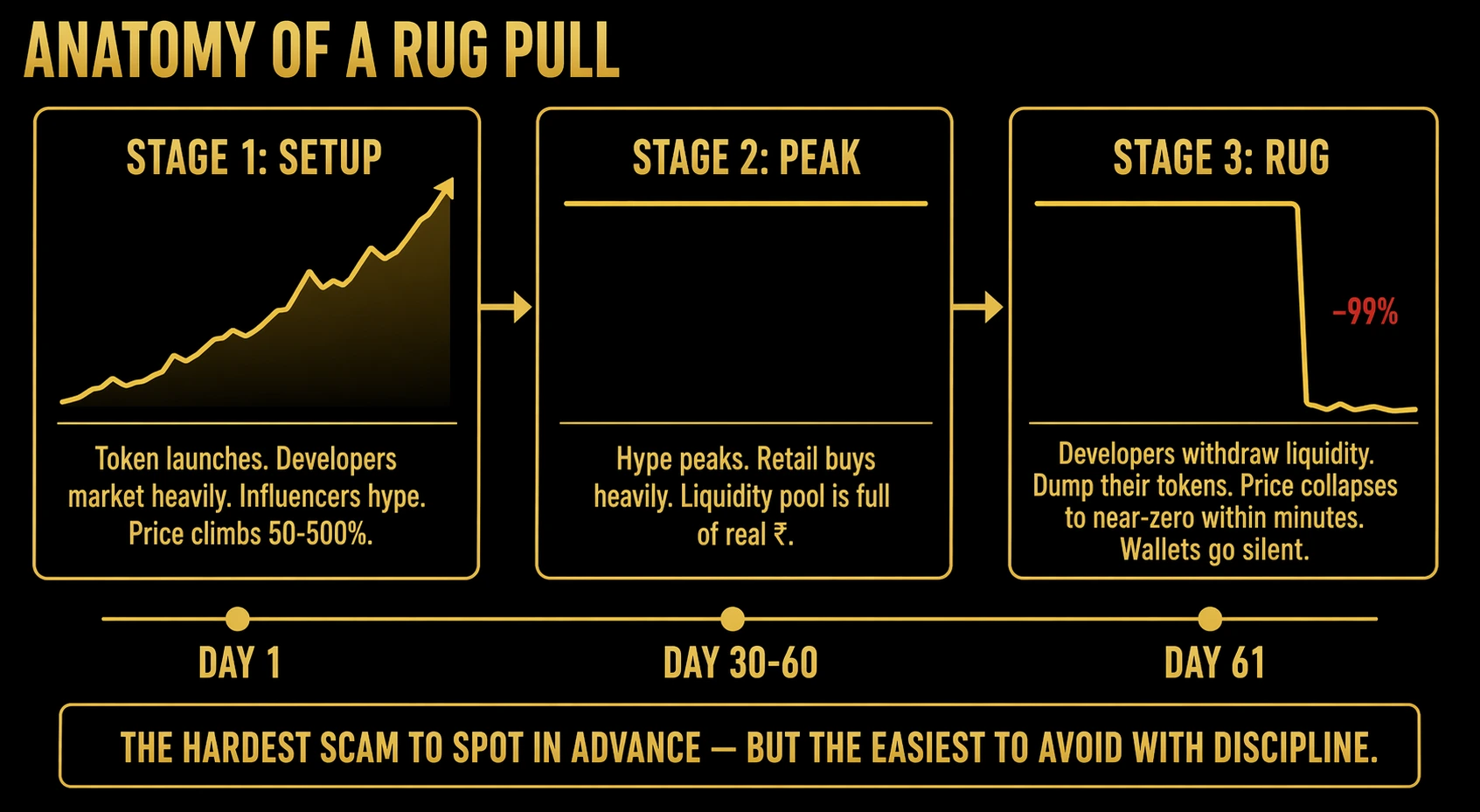
The three stages of a rug pull — setup, peak, and the sudden drop to near-zero.
Here is the three-stage pattern almost every rug pull follows:
Stage 1 — Setup (Day 1-60). The team launches a new token with a catchy name and flashy website. They create a professional-looking roadmap, promising features like "cross-chain swapping" or "AI-powered trading". They hire crypto influencers on Twitter, YouTube, and Telegram to promote the token. Paid articles appear in low-quality crypto news sites. Price starts rising. Early buyers see 50-200% gains. They start spreading the word organically. FOMO begins.
Stage 2 — Peak (Day 45-90). The token is trending. Price has risen 500-2,000%. The team announces exciting new partnerships (often fake). A small amount of retail money pours in daily. The "community" is euphoric. The original team is sitting on massive amounts of tokens they gave themselves at launch for free. They are also watching the liquidity pool fill up with real money from buyers.
Stage 3 — The Rug (one specific day). Within a single hour, the developers do one of two things. Option A (hard rug): They remove the liquidity from the trading pool — taking all the real money with them. The token immediately becomes un-sellable. Option B (soft rug): They sell their massive pre-allocated tokens gradually on the open market, crashing the price while extracting real money. Either way, within hours, the price drops 90-99%. The Telegram group goes silent. The website disappears. The team's Twitter accounts go private. The money is gone.
How to spot rug pulls before they happen. You cannot always. But these warning signs increase the probability:
- Anonymous team. No real names, no real backgrounds, no public accountability.
- Token age less than 6 months. The longer a token has existed without rugging, the safer (though never 100% safe).
- Heavy concentration of tokens in few wallets. If the top 10 wallets own 70%+ of the supply, they can crash the price anytime.
- Unlocked liquidity. In real projects, liquidity is "locked" in a smart contract for a fixed period (typically 6-24 months). If liquidity is not locked, developers can pull it any time.
- Promises that sound too good. "100x potential", "next Bitcoin", "guaranteed moon" — real projects do not talk this way.
- Hype much bigger than actual product. If the marketing is 10x louder than the actual usage of the product, something is off.
The simplest way to avoid rug pulls is to only buy tokens that have been live for at least 1 year, have real teams, real products being used, and are listed on major exchanges. Our tokenomics guide teaches you how to analyse a token's fundamentals. Understanding how whales manipulate small-cap coins — covered in our whale manipulation guide — also helps you avoid these traps.
Phishing — how attackers steal your wallet
Phishing is the scam that has stolen more individual crypto wallets than any other. It is also the easiest to avoid once you know what to look for.
Phishing works by tricking you into entering your password or seed phrase on a fake website or app. The fake looks exactly like the real. You think you are logging in to your exchange. Actually you are typing your password into the scammer's server. They capture it. Minutes later, they log into your real account and steal everything.
Common phishing methods:
1. Fake login emails. You get an email that looks like it is from Binance or WazirX. It says "Your account has been compromised. Click here to verify." The link goes to a fake website. You enter your password. Attacker captures it.
2. Fake support on social media. You post a question about a wallet issue on Twitter or Reddit. Within minutes, a "support agent" DMs you offering to help. They ask you to "verify your seed phrase" in a form. Seed phrase gone. Wallet drained.
3. Fake browser extensions. You download what you think is MetaMask from a Google search. Actually it is a fake MetaMask that steals your seed phrase when you create or import a wallet.
4. Fake Google ads. You search "Binance login". The first result is a paid ad. It looks exactly like Binance. But the URL is slightly off — "b1nance.com" instead of "binance.com". You enter your credentials into the fake site.
5. Airdrops to your wallet. Strange tokens appear in your wallet. You try to sell them. A website says "connect your wallet to claim". You connect. The contract drains your wallet.
Rules to defeat phishing:
- Always type URLs directly. Never click crypto-related links in emails, messages, or search ads. Type the URL yourself (like binance.com or metamask.io) or bookmark the real site and use the bookmark.
- Never share your seed phrase. Not with support. Not with friends. Not with anyone, ever. Legitimate services never ask for it.
- Double-check URLs. Before entering any password, look at the URL carefully. "binance.com" is real. "binance-support.com" is fake. "binance.com.fraudsite.com" is fake.
- Use 2FA (two-factor authentication). Even if your password is stolen, 2FA via an authenticator app (not SMS) provides a second layer of security.
- Ignore unexpected airdrops. If random tokens appear in your wallet, do not interact with them. Leave them alone. Many are designed to drain wallets when you try to sell them.
- Never let anyone remote-control your computer. No legitimate support needs remote access to your PC.
If you follow just these six rules, you will defeat 95% of phishing attacks. The other 5% require some luck, but they are rare if you are careful.
How to check if a project is real or fake
Before you invest in any new crypto project, spend 15 minutes verifying it. This small effort can save your entire investment.
Check 1 — The team. Go to the project's website. Find the team page. Do the names match real LinkedIn profiles? Do the team members have verifiable work history at real companies? If the team is anonymous or the profiles look fake, consider this a major red flag.
Check 2 — Age of the project. When was the project launched? You can check the token's creation date on block explorers like Etherscan (for Ethereum tokens) or BscScan (for BSC tokens). A project less than 6 months old is risky. Less than 1 month old is very risky.
Check 3 — Token distribution. On a block explorer, check "Top Holders" of the token. If the top 10 wallets own 70%+ of the total supply, those few wallets can dump and crash the price anytime. Healthy distributions have tokens spread across thousands of wallets with no single wallet owning more than 5%.
Check 4 — Liquidity. On the DEX where the token trades, check the liquidity pool. Is there at least $500,000 in liquidity? Less than that means the token can be easily manipulated. Is the liquidity locked in a smart contract for a fixed period? Unlocked liquidity = higher rug pull risk.
Check 5 — Real usage. Does the project have a working product? Is anyone actually using it? Check usage stats, transaction counts, active wallet counts. Real usage is hard to fake. Many scam projects have fancy websites but zero real usage.
Check 6 — Social media quality. Check the project's Twitter, Telegram, Discord. Are the followers real or fake? (Fake followers usually have no posts of their own and random-looking usernames.) Are the Telegram discussions genuine or just bots repeating "to the moon"?
Check 7 — Audit. Has the smart contract been audited by a reputable security firm? Real audits from firms like CertiK, PeckShield, or Trail of Bits are published publicly. No audit or fake audit reports = high risk.
Check 8 — Reviews from trusted sources. What do trusted crypto research accounts say? Not influencers who are paid to promote, but independent analysts with clean track records. If nobody credible is covering the project, be suspicious.
You do not need to score a project perfect on all 8 checks. But if it fails 3 or more, it is not worth your money. There are thousands of real projects to invest in. Do not take unnecessary risks with sketchy ones. Before you invest in anything, also read our safe buying guide for Indian users to make sure you are buying the right way.
What to do if you have been scammed
If you have already been scammed, the honest truth is that recovery is very difficult. But there are still things you should do immediately.
Step 1 — Stop sending more money. If the scammer is still in contact (especially in pig-butchering scams), cut off all communication. Do not send "fees" or "taxes" to recover your money. It is gone. Sending more will only increase your loss.
Step 2 — Secure your accounts. Change all your passwords. Enable 2FA on every crypto service you use. If your seed phrase was exposed, create a new wallet and move any remaining funds to the new wallet immediately.
Step 3 — File a police complaint. In India, you can file a cybercrime complaint at cybercrime.gov.in or at your local police station. While crypto scam recoveries are rare, filing an FIR creates an official record and contributes to larger investigations.
Step 4 — Report to the crypto exchange (if applicable). If the scam involved an exchange transaction, report it to the exchange's support immediately. Sometimes, if the stolen funds are still on the exchange, they can be frozen.
Step 5 — Report to blockchain tracking services. Services like Chainalysis track stolen crypto. Your exchange or the cybercrime cell may work with such services. Reporting the scam helps future victims.
Step 6 — Warn others. Post about the scam publicly (without revealing your personal details). Warn your communities. Your experience can save others from the same fate.
Step 7 — Beware of "recovery services". Scammers often target scam victims with a second scam — offering to "recover your lost funds" for a fee. These are almost always fake. No legitimate service can recover crypto that has already been moved to a scammer's wallet. Paying a recovery service is throwing good money after bad.
Step 8 — Learn and move forward. The hardest part. Take time to process the loss. Understand exactly what pattern fooled you. Read this entire guide twice. Then, eventually, when you are ready, return to crypto with a more careful approach. Being scammed once does not mean you cannot be successful in crypto — it means you have learned a very expensive lesson that many others also learn.
The pain of being scammed is real. But you are not alone. Thousands of Indians face the same situation every year. What matters is what you do next — protect yourself, help others, and keep learning.
Safe habits that protect you for life
These are the daily habits that separate people who lose money to scams from people who never do. Build them into your routine.
Habit 1 — Never decide in a hurry. Any decision that feels urgent is probably being pushed on you by someone who benefits. Real opportunities do not vanish in 10 minutes. Take at least 24 hours to investigate any new "opportunity".
Habit 2 — If you do not understand it, do not buy it. Do not invest in something because your friend made money, or because an influencer recommends it, or because it is trending. Invest only in things you can explain to someone else in simple words.
Habit 3 — Use hardware wallets for large amounts. If your crypto holdings exceed ₹1-2 lakh, move them to a hardware wallet (like Ledger or Trezor). These are physical devices that keep your keys offline. No phishing can reach them.
Habit 4 — Use different passwords for each crypto service. Password managers make this easy. If one service is compromised, your others stay safe.
Habit 5 — Turn on 2FA using an authenticator app. Not SMS-based 2FA (SMS can be hacked via SIM-swap attacks). Use Google Authenticator, Authy, or a similar app.
Habit 6 — Trust but verify. Even if information comes from a trusted source, verify it independently before acting on large decisions.
Habit 7 — Never chat with strangers about money. If someone you do not know messages you about crypto investments, trading platforms, or "opportunities", block them. Especially if they seem friendly or attractive.
Habit 8 — Keep your crypto success quiet. Do not announce your gains on social media. Do not show your wallet balances publicly. Broadcasting wealth attracts both online and offline attackers.
Habit 9 — Continue learning. Scam methods evolve. A scam pattern that did not exist 2 years ago may be common now. Stay connected to trusted crypto education sources.
KAVACH — Protect your capital with a structured safety framework
KAVACH is our protection framework covering wallet security, scam recognition, position sizing, and the recovery protocols that save accounts after a bad decision. If you are new to crypto, building this defensive base before chasing gains is the most important thing you can do.
Explore the Store →One final thought. Crypto can genuinely change your financial future. It has done so for millions of people, including many Indians. But the same openness that makes crypto revolutionary also makes it dangerous. The responsibility to protect yourself is entirely yours. No bank, no government, no exchange will save you.
The good news is that defence is much easier than offence. Scammers need to be right every time to succeed. You only need to be careful every time to stay safe. And carefulness is a habit, not a talent. Anyone can build it.
Join our Telegram community where members share new scam alerts regularly — learning from others' experiences is one of the best defences. Our beginner crypto course includes a full module on security and scam prevention. Stay curious. Stay cautious. Stay safe.
Frequently asked questions
How do I know if a crypto project is a scam?
Check 8 things: real team with verifiable identities, project age over 6 months, token distribution not concentrated in few wallets, locked liquidity, real product usage, genuine social media community, published security audit, and coverage by independent analysts. If a project fails 3 or more of these checks, avoid it. There are thousands of real projects — do not risk money on sketchy ones.
Can I get my money back if I was scammed in crypto?
In most cases, recovery is extremely difficult because crypto transactions cannot be reversed. File a complaint at cybercrime.gov.in and with your local police. Report to the exchange involved. However, beware of 'recovery services' that claim to get your money back — they are almost always second scams targeting scam victims. Focus instead on securing your remaining accounts and learning from the experience.
What is the biggest warning sign of a crypto scam?
Any request for your seed phrase or wallet private keys. No legitimate exchange, wallet, project, or support service will ever ask for your seed phrase. If anyone asks — customer support, a project team, a 'verification' process — it is 100% a scam. The seed phrase gives complete control of your crypto to whoever has it. Never share it. Ever.
Are all new crypto tokens scams?
No, but many are. Roughly 50-70% of new tokens launched each year fail or turn out to be scams. Safer approach for beginners: stick to established projects that have existed for 2+ years with real usage. If you want to explore new projects, commit only small amounts you can afford to lose, and only after completing the 8-point verification checklist.
How do I report a crypto scam in India?
File a complaint at cybercrime.gov.in (National Cyber Crime Reporting Portal) or at your local cybercrime police station. Provide all transaction details, communication records, and scammer information. Also report to the exchange involved if applicable. While recovery is rare, reporting creates an official record and contributes to larger investigations that can help prevent future scams.
cRyPtO sMaRt is not registered with SEBI and does not provide investment advice. Crypto trading carries significant risk of capital loss. The strategies, examples, and opinions shared in this article are for educational purposes only. Always do your own research and consult a SEBI-registered financial advisor before investing real capital. Past performance does not guarantee future results.