
- What is an AI trading bot, in simple words?
- How AI trading bots actually work
- The 4 most common bot strategies explained
- Realistic returns — the honest numbers
- Where to find legitimate trading bots
- How to set up your first bot safely
- Risks nobody mentions until it is too late
- When bots actually help and when they hurt
- Frequently asked questions
What is an AI trading bot, in simple words?
An AI crypto trading bot is a computer programme that buys and sells crypto for you automatically. You set some rules. The bot follows those rules 24 hours a day. It never sleeps. It never gets emotional. It just follows the plan.
Imagine you hired a person to watch crypto charts all day. This person has one job — buy when the price drops to a certain level, sell when it rises to another level. They do this tirelessly, without panic, without greed. That is basically what a trading bot does — except it is software, not a person.
The word "AI" (artificial intelligence) is often used loosely in crypto marketing. Some bots are truly AI-powered — they learn from past data and adjust their strategy. Others are just simple rule-followers, called "automated bots". Both types get sold as "AI trading bots" these days, so be careful what you are actually buying.
Here is what a typical bot can do:
- Watch the price of one coin or many coins at the same time.
- Place buy or sell orders automatically when conditions are met.
- Set stop-losses and take-profit levels without you watching.
- Trade across multiple exchanges at once.
- Execute hundreds of small trades per day if you want.
Here is what a bot cannot do:
- Predict the future. No bot knows what price will do next.
- Turn ₹10,000 into ₹10 lakh in a month (despite what ads claim).
- Protect you from market crashes that break every pattern.
- Replace your judgement during unusual events (like news shocks).
Let me be honest with you. Most people who buy trading bots expect easy money. They imagine a magic machine that makes them rich while they sleep. This is a fantasy. Bots can be useful tools. But they are not a shortcut to wealth. Over 80% of retail bot traders lose money or make less than they could have with simple dollar-cost averaging.
This guide will show you the truth about trading bots. What they really do. How much they really make (or lose). When they actually help. And when they are just a clever way to empty your wallet through fees and bad trades. By the end, you will know if a bot fits your style — or if you are better off without one.
How AI trading bots actually work
To understand if bots can help you, you need to understand how they really work under the hood. Do not worry — this does not need any coding knowledge.

An AI bot at work — scanning, analysing, deciding, and executing, all within milliseconds.
Every trading bot has five basic parts:
1. Data input. The bot reads market data in real time — current price, trading volume, order book depth, moving averages, and whatever other data points its strategy needs. Most bots connect to exchanges via APIs (a way for two computers to talk to each other).
2. Strategy engine. This is the bot's brain. It has a set of rules. For example: "if RSI drops below 30 AND price is above the 200-day moving average, place a buy order for ₹5,000 worth of ETH". The strategy can be simple or complex, pre-built or custom.
3. Risk management. Good bots have safety rules. Position size limits. Stop-loss levels. Maximum daily loss caps. Without these, a single bad streak can wipe out your account.
4. Execution module. Once the bot decides to trade, it sends the order to the exchange through an API. Most bots use "market orders" for speed, but some use "limit orders" for better prices.
5. Monitoring dashboard. You get a live view showing what trades have happened, current positions, total profit or loss, and performance metrics. Some bots send Telegram alerts or emails.
The two main types of bots:
Rule-based bots (most common). These follow fixed rules you set up. They do not learn. If the market changes, they keep following the old rules until you change them. 90% of bots being sold to retail traders are this type, even when they are branded "AI".
True AI bots (rare). These use machine learning. They look at years of historical data, find patterns, and adjust their strategies over time. They can improve as they collect more data. Building a real AI bot requires data science skills and months of testing. Most retail traders never touch these.
The API connection is crucial to understand.
When you use a bot, you give it permission to trade on your exchange account through an API key. Most bots only need "trade" permissions — they should never need "withdraw" permission. If a bot asks for withdrawal access, run away. No legitimate bot needs that — it is a red flag for theft.
The API key lives on the bot's server (or your computer if self-hosted). The bot uses this key to place trades on your behalf. Your crypto stays in your exchange account. The bot cannot take it out — unless you gave withdraw permission by mistake.
This setup is both the power and the danger of bots. Power: the bot can trade while you sleep. Danger: if the bot's server is hacked, your trading can be manipulated (though your coins usually stay safe).
The 4 most common bot strategies explained
Not all bots do the same thing. Different bots use different strategies. Here are the four most common types — explained in simple terms.
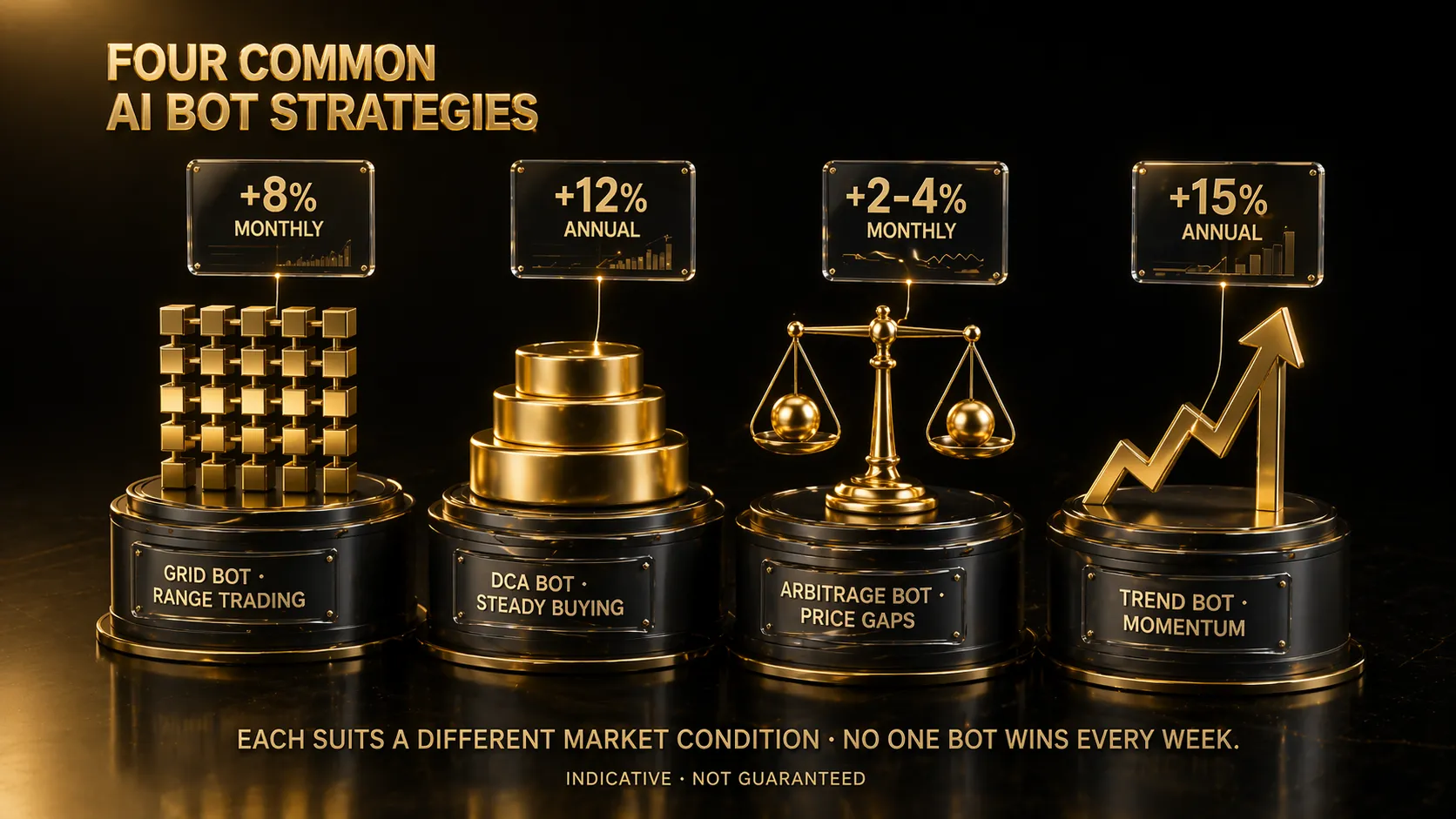
The four most common bot strategies — each suits a different market condition.
1. Grid trading bot (range-bound markets)
A grid bot works best when the price is moving sideways within a range. Imagine BTC is moving between ₹55 lakh and ₹65 lakh. The bot divides this range into small "grid lines" — say, every ₹1 lakh. It places a buy order at each grid line below the current price and a sell order at each grid line above.
Every time the price touches a grid line, a trade fires. If the price falls to ₹58 lakh, the bot buys. If the price rises to ₹60 lakh, the bot sells at profit. The bot keeps repeating these small profits as the price oscillates.
Works well when: price is moving in a range. Fails badly when: price breaks out of the range in one direction and keeps going.
Realistic returns: 2-6% per month in good ranging conditions, but losses when markets trend strongly.
2. DCA bot (dollar-cost averaging)
A DCA bot buys a fixed amount of crypto at fixed intervals — for example, ₹2,000 of BTC every week. It does not care about price. It just keeps buying slowly and steadily. Over time, this builds a position at an average price that is usually reasonable.
Some DCA bots add a twist — they buy more aggressively when price drops below certain levels. This is called "smart DCA" or "laddered DCA".
Works well when: you want to accumulate long term without timing the market. Fails badly when: the coin you are DCA-ing into is a bad coin that keeps falling forever.
Realistic returns: matches the long-term performance of the coin, minus fees. Over 5-10 years on BTC or ETH, this has historically been very profitable. Read our DCA guide for the full approach.
3. Arbitrage bot (price differences)
An arbitrage bot watches the same coin on multiple exchanges. When the same coin is priced differently on two exchanges — say, ₹60,00,000 on Exchange A and ₹60,05,000 on Exchange B — the bot buys on A and sells on B, pocketing the ₹5,000 difference.
In 2015-2018, arbitrage was a goldmine. Today, the big gaps are gone. Professional firms with millisecond-fast connections have taken most of the profit. Retail arbitrage bots now earn maybe 0.1-0.5% per trade after fees.
Works well when: you have access to multiple exchanges with different prices (harder in India). Fails badly when: transfer times are slow (price gap closes before your money arrives).
Realistic returns: 1-3% per month in good conditions, often less after accounting for fees.
4. Trend-following bot (momentum)
A trend-following bot buys when price starts rising strongly and sells when the trend weakens. It uses indicators like moving averages to spot trends. The logic is simple: "the trend is your friend — ride it while it lasts".
These bots work brilliantly during strong bull runs and bear markets. They struggle in sideways, choppy markets — which is most of the time in crypto.
Works well when: markets are trending clearly (up or down). Fails badly when: markets are choppy and sideways (fake signals trigger losses).
Realistic returns: highly variable — can make 50%+ in a strong trend year, can lose 20-30% in choppy years.
No single bot strategy wins every market condition. This is important to understand. A grid bot that made 8% per month during a sideways summer can lose 15% in a single week when price breaks out. Many retail traders switch between bots chasing whichever strategy performed best last month — which is usually the worst one to pick next month.
Realistic returns — the honest numbers
This is the most important section of this guide. Most bot marketing is pure lies. Let me show you the honest truth about what bots really return.
What bot sellers show you:
- "+320% in 6 months!" (selected best month, hidden losses)
- "Our AI beats 95% of traders" (no data, no audit)
- "₹10,000 became ₹5,00,000 in 1 year" (cherry-picked example)
- Beautiful backtested charts showing smooth upward curves
What real bot results look like:
- Most retail bot users lose money over a full market cycle
- The best realistic returns for a well-run bot are 1-3% per month, not per week
- Drawdowns of 30-50% are normal even for profitable bots
- "Guaranteed profit" bots are always scams
Why backtests lie.
Backtesting means running a strategy on past data to see what it would have returned. Sellers show you perfect backtests. The problem: past data is known. Future data is not. A strategy that would have made 200% last year may lose 30% next year. The market changes. What worked before stops working.
There is also a dirty trick called "curve fitting". This means tweaking a strategy until it fits past data perfectly. The problem: a perfectly-fit strategy almost always fails in live trading. Good bot builders test on one period, then validate on a different period. Most bot sellers skip this step because it breaks their marketing numbers.
Realistic monthly returns by strategy (after fees, based on retail trader data):
- Grid bot in range markets: +2% to +6% per month when conditions suit it; -5% to -15% when they do not.
- DCA bot: matches coin performance over years. On BTC since 2015, roughly +40-60% annualised, but with 70%+ drawdowns during bear markets.
- Arbitrage bot: +1% to +3% per month, very consistent but low volumes needed to make it worthwhile.
- Trend-following bot: +50% in strong trend years, -20% to -30% in choppy years. Very inconsistent.
The hidden cost that kills returns — fees.
Every trade costs money. Exchange fees, spread, slippage (the difference between expected and actual fill price). Plus, in India, every crypto sale triggers 1% TDS and all profits are taxed at 30%. A bot doing 200 trades per month can easily lose 5-10% of gross returns just to fees and taxes. Our crypto tax guide covers this in detail.
Be suspicious of any bot advertising returns above 10% per month consistently. These numbers usually come from:
- Curve-fitted backtests
- Cherry-picked time periods
- Outright lies
- Returns that held briefly before blowing up
The best realistic goal with a bot is to slightly outperform DCA while keeping the same or lower risk. If a bot cannot do that, it is not worth the effort or fees.
Where to find legitimate trading bots
There are three main places to get bots. Each has pros and cons.
1. Established bot platforms (best for beginners).
Platforms like 3Commas, Pionex, Bitsgap, and Cryptohopper are large companies with years of track record. They offer pre-built strategies, paper trading, and decent customer support. You connect your exchange account via API and pick from their strategy library.
Cost: typically $15-50 per month for basic plans. Higher tiers with more features cost $100-300 per month.
Pros: user-friendly, audited code, large communities to ask questions, no coding needed. Cons: you are trusting a third party with your API keys, monthly subscription eats into profits, the best strategies are not available on free tiers.
2. Exchange-provided bots (easiest).
Major exchanges like Binance and OKX offer their own bot features directly. You can set up a simple grid bot or DCA bot without any third-party service. The exchange handles everything.
Cost: usually free (except normal trading fees). Indian exchanges are starting to offer similar features.
Pros: no API keys to share, no monthly fees, secure by default. Cons: limited strategy options, less customisation, fewer advanced features.
3. Custom-built or open-source bots (advanced).
If you can code or are willing to learn, you can run open-source bots like Freqtrade, Gekko, or Hummingbot on your own server. You have full control, full customisation, and no third-party risk.
Cost: free software. You pay only for server hosting (₹500-2,000 per month).
Pros: no subscription costs, full transparency (you can read the code), no data sharing. Cons: requires coding skills, takes weeks to set up properly, you are responsible for everything — including mistakes.
How to evaluate any bot service before trusting it:
- How long has the company existed? Less than 2 years = high risk. Look for 5+ years.
- What exchanges does it support? Indian exchanges integration is important for Indian users.
- Does it offer paper trading? You must be able to test strategies with fake money first.
- Is the pricing clear? Hidden fees and performance-based pricing often hide problems.
- What do real users say on Reddit/Twitter? Not official reviews — actual user discussions. Look for patterns of complaints.
- Does it claim guaranteed returns? If yes, scam. Real bots can lose money.
- Does it ask for withdrawal permission? If yes, major red flag. Walk away.
Our crypto scam guide covers more red flags that apply to bot platforms specifically — many of the worst bot scams use the same patterns as pump-and-dump groups and fake airdrops.
How to set up your first bot safely
If you have decided to try a bot, here is a safe way to start. Follow these steps strictly.
Step 1 — Start with paper trading. Every legitimate bot platform lets you run strategies with fake money first. Do this for at least 4-6 weeks before using real money. Watch how the bot behaves in different market conditions. Get comfortable with its behaviour.
If a bot service does not offer paper trading, skip it. No exceptions.
Step 2 — Pick one simple strategy. For your first bot, pick the simplest strategy available — usually a DCA bot buying BTC or ETH weekly. Do not touch grid bots, multi-coin strategies, or leveraged bots until you have months of experience.
The "simpler is better" rule in trading applies doubly to bots.
Step 3 — Set up API keys correctly. When creating an API key on your exchange for the bot, apply these restrictions:
- Enable: "read" and "trade" permissions only.
- Disable: "withdraw" permission always. This is the single most important security step.
- IP whitelist: restrict the API key to the bot's server IP only. Most platforms tell you their IP.
- Expiry: if your exchange allows setting an expiry date, use 90 days maximum. Rotate keys every quarter.
If the exchange supports 2FA on API changes, enable it. Every time.
Step 4 — Start with a tiny amount. Your first real-money bot should trade with an amount you can fully afford to lose. ₹5,000-10,000 is typical. Do not put ₹1 lakh in your first bot no matter how good the backtest looks.
Run this small amount for at least 2-3 months before adding more capital. Even if results are good, do not increase too fast. Scaling slowly lets you catch problems before they become expensive.
Step 5 — Monitor actively for the first month. "Set and forget" is a myth. For the first month, check the bot's trades every day. Make sure it is trading as expected. Make sure fees are not eating too much of the profit. Make sure the bot is still connected to the exchange.
After a month, you can reduce monitoring to every few days. But never completely forget.
Step 6 — Set hard stop rules. Before you start, write down two numbers:
- Maximum drawdown — the deepest loss you will accept before switching off the bot. Usually 20-30% of the capital you assigned to the bot.
- Review trigger — the size of loss that makes you sit down and review why. Usually 10-15%.
When either number is hit, act. Do not hope the bot will recover. Many traders have watched a 10% loss turn into a 50% disaster because they refused to intervene. Our market psychology guide explains why this hesitation is one of the most common trading mistakes.
Step 7 — Review performance monthly, not daily. After the first month of close monitoring, switch to monthly reviews. Check:
- Total return after fees and tax
- Number of trades and win rate
- Maximum drawdown during the month
- Whether the strategy still fits current market conditions
Keep a simple spreadsheet with these numbers month by month. After 6-12 months, you will have real data to judge the bot fairly — not marketing claims, not short-term luck, but your own results.
Risks nobody mentions until it is too late
Bot sellers love talking about returns. They rarely talk about risks. Here are the ones that sink most retail bot users.
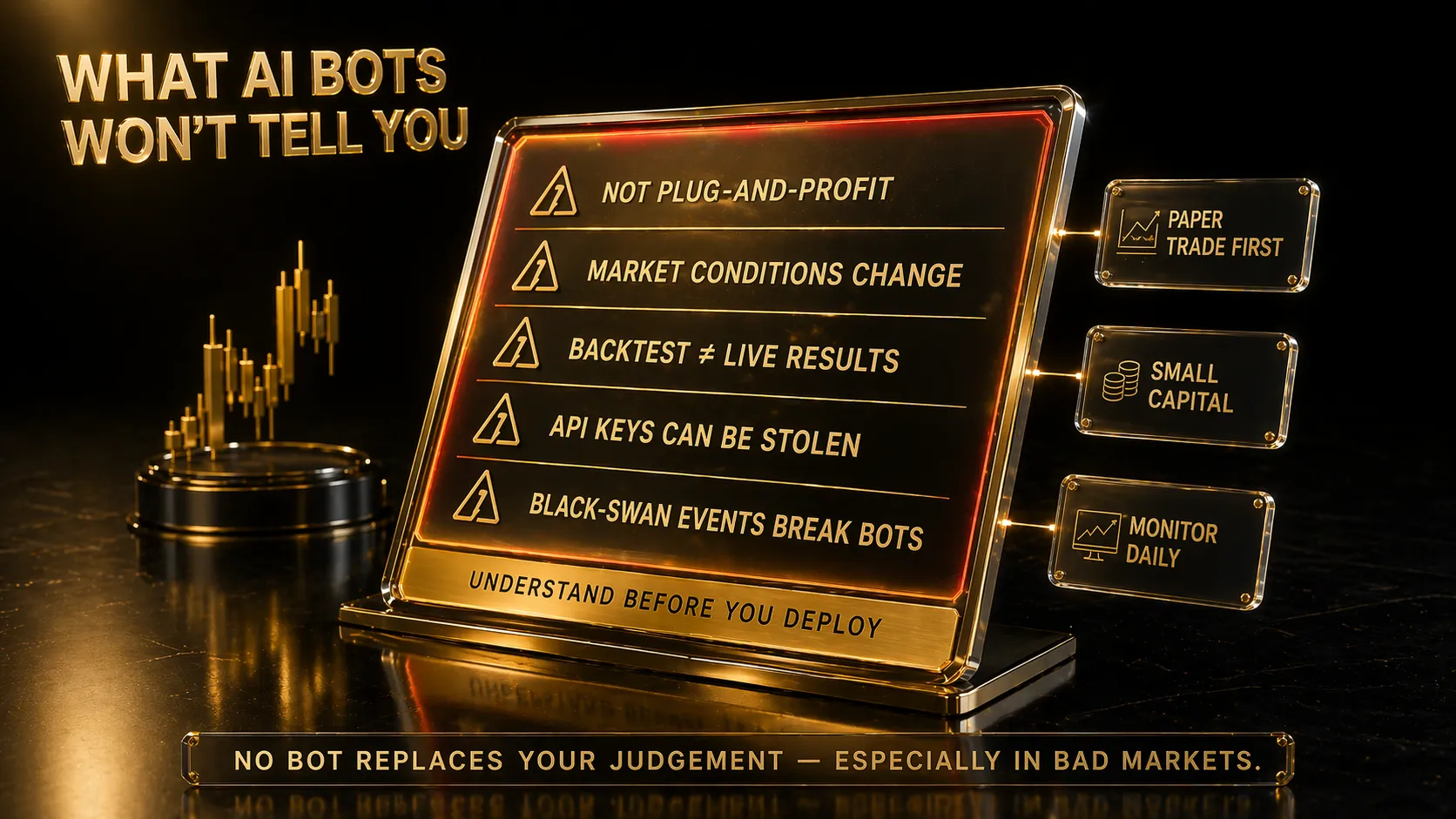
The five warnings every trader should read before deploying any bot.
Risk 1 — Market conditions change. A bot that worked perfectly in 2023 may fail badly in 2024. Crypto markets go through distinct phases — bull, bear, sideways, high-volatility, low-volatility. A bot optimised for one phase usually performs poorly in another. The 2022 bear market wiped out countless bots that had performed brilliantly in 2021.
Risk 2 — Backtest vs live reality gap. Backtests assume perfect execution — no slippage, no fees, no downtime. Live trading has all of these. A backtest showing +40% per year often becomes +5% in live trading after real-world friction. Some bots actually lose money in live trading despite showing big backtest profits.
Risk 3 — API key theft. Your API key is a password. If a hacker steals it, they can trade on your exchange account. They cannot withdraw (if you followed Step 3 above), but they can trade your balance into worthless coins at terrible prices — effectively stealing through bad trades. This happens more often than you think, especially with shady bot providers.
Risk 4 — Platform shutdowns. Some bot platforms disappear overnight. Server issues, bankruptcy, or regulatory problems can mean your bot stops trading — sometimes at the worst possible moment. If the platform holds your funds (avoid these), you may lose them completely.
Risk 5 — Black-swan events break every bot. A massive market crash, an exchange hack, a major geopolitical event — these are black-swan events. Bots are programmed for normal conditions. They have no idea what to do when everything breaks at once. In March 2020 (COVID crash), in May 2021 (China mining ban), in November 2022 (FTX collapse), countless bots got caught on the wrong side and blew up accounts.
Risk 6 — Over-optimisation (curve fitting). A bot that backtests at +200% per year is probably curve-fit to past data. It has been tuned so perfectly to what already happened that it cannot handle what happens next. The best backtests often produce the worst live results.
Risk 7 — Subscription cost drag. ₹5,000 per month for a premium bot subscription sounds small. On a ₹50,000 trading account, it is 10% annual cost — before any fees or taxes. You need to beat DCA by more than 10% per year just to break even on the subscription.
Risk 8 — Emotional false confidence. Good bot results for 3-6 months make traders confident. They add more capital. They switch to higher-risk strategies. Then one bad month wipes out a year of gains. Bot success tends to breed overconfidence that causes the next loss.
Risk 9 — Bot complexity hides problems. Complex bots with many parameters are harder to understand. If something goes wrong, you may not know why. Simple bots with 2-3 rules are easier to debug and safer for beginners.
Risk 10 — Regulatory uncertainty in India. Indian law around automated crypto trading is evolving. Using bots is currently not illegal, but the tax treatment of high-frequency trades (many small trades per day) is less clear than long-term investing. Consult a CA if you plan to run high-volume bots.
Bots are tools. Like any tool, they can be used well or badly. Used badly, they amplify every mistake a human trader makes — but faster and more consistently. The biggest risk with bots is not the bot itself. It is the trader behind the bot who thinks the bot will save them from poor judgement.
When bots actually help and when they hurt
Let me end this guide with a clear, honest summary. Bots help some people and hurt others. Here is how to tell which group you fit into.
When bots actually help:
1. You lack discipline for simple strategies. If you know DCA works but you keep skipping weeks, forgetting to buy, or trying to "time" your buys, a simple DCA bot enforces the discipline you lack. This is probably the most useful bot scenario for beginners.
2. You have a proven strategy but no time to execute it. If you have tested a simple rule-based strategy yourself and know it works, a bot can run it 24/7 while you go to your day job. But you need the strategy first. Buying a pre-built bot hoping it has a working strategy usually ends in losses.
3. You are running arbitrage at scale. If you have significant capital and multiple exchange accounts, arbitrage bots can produce consistent small profits that would be impossible to capture manually.
4. You want emotional separation from trading. Watching charts all day leads to bad decisions — panic selling, FOMO buying, over-trading. A bot removes the emotional trader from the equation. Some investors who kept blowing up manual trading accounts have done well simply by switching to a simple automated DCA bot.
When bots usually hurt:
1. You are trying to get rich quick. Bots promising 10-30% per month are selling fantasy. You will lose money. Period.
2. You cannot code and the bot platform is opaque. If you cannot read the bot's rules or understand what it is doing, you cannot know when to stop it. You are flying blind.
3. You have less than ₹20,000 to test with. Subscription fees and trading costs eat small accounts. You cannot scale results meaningfully at small sizes.
4. You do not have time to monitor. "Set and forget" is a lie. Even good bots need monthly review. If you cannot commit an hour per month to check performance, do not use a bot.
5. You trust bot sellers' marketing. If a salesperson's pitch excites you, you are already the target. Successful traders are sceptical by default.
6. You cannot afford to lose the capital. Every bot can blow up. If losing the money would hurt your life, do not risk it.
VIDYA MANDAL — Understand automation before you deploy it
VIDYA MANDAL is our structured knowledge library covering bot fundamentals, strategy selection, API security, and performance review frameworks. If you want to use automation without becoming its victim, understanding the machinery first is the only safe path.
Explore the Store →A final honest thought. I have used trading bots for years. The single most profitable "bot" I ever ran was a simple DCA script buying ₹1,000 of BTC every Monday at 9 AM. No AI. No complex strategies. Just consistent automated buying through good markets and bad. That simple setup beat every fancy bot I tried.
Fancy does not mean better. Automation does not mean profit. Technology does not replace judgement. Use bots as tools to enforce simple discipline — not as magic money machines. If you approach them that way, they can genuinely help. If you approach them as a shortcut to wealth, they will teach you an expensive lesson.
Join our Telegram community where we share real experiences with bots — including losses, not just wins. Our crypto education courses include a full module on automation discipline and when it genuinely helps. Start simple. Start small. Stay honest with yourself about results.
Frequently Asked Questions
Can AI trading bots really make consistent profits in crypto?
Some can, but not the way marketing suggests. The best realistic returns from a well-run bot are 1-3% per month — not per week, and not 10-30% per month as ads often claim. Most retail bot users lose money or make less than simple dollar-cost averaging would have made. Bots amplify whatever strategy they run — good strategies with discipline can profit; bad strategies fail faster with a bot than without one.
How much money do I need to start using a crypto trading bot?
Start with ₹5,000-10,000 for your first live bot to learn. With less than ₹20,000-30,000 total capital, subscription fees and trading costs typically eat most profits — making DCA without a bot more efficient. Only scale up to larger amounts after at least 3-6 months of successful small-scale operation. Avoid putting money into bots that you cannot fully afford to lose.
Are crypto trading bots legal in India?
Yes, using trading bots is currently legal in India — there is no specific ban. However, all crypto profits (whether from manual trading or bot trading) are subject to the same 30% flat tax plus 1% TDS on sales. High-frequency bots creating many trades per day may complicate tax filing and bookkeeping. Consult a chartered accountant familiar with crypto if you plan to run volume bots.
What is the safest way to connect a bot to my exchange account?
Use API keys with 'read' and 'trade' permissions only — never enable 'withdraw' permission. Apply IP whitelisting to restrict the key to the bot's server only. Set the key to expire within 90 days and rotate quarterly. Enable 2FA on API changes. Never share your API key with multiple services. If a bot service asks for withdrawal permission, treat it as a scam and walk away immediately.
How do I know if a crypto trading bot is a scam?
Major red flags: guaranteed returns of any size, promises over 10% per month consistently, requests for withdrawal API permissions, anonymous teams with no public track record, fake testimonials, no paper-trading option, and pressure to upgrade to 'premium' tiers. Legitimate bots always let you paper-trade first, offer transparent pricing, have multi-year track records, and honestly disclose that losses are possible. If it sounds too good to be true, it is.
This article is for educational purposes only and does not constitute financial advice. Crypto investments are subject to market risk and are not regulated by SEBI or RBI in India. Past performance does not guarantee future results. Always do your own research, consult a registered financial advisor, and never invest more than you can afford to lose. cRyPtO sMaRt and Avik Kanrar are not liable for any trading decisions or losses based on this content.